So, in regards to a function, we talked about linear, quadratic, and cubic. The difference in all these functions are the powers. Now, why is the equation important? Is it because i can make a table, and using the equations, plot my curve?
Yes, you're absolutely right! The equation of a function is incredibly important precisely because it allows you to:
- Make a table of values: You pick different input values for 'x', plug them into the equation, and calculate the corresponding output values for 'y'. This gives you a set of (x, y) coordinate pairs.
- Plot your curve: Once you have these (x, y) pairs from your table, you can plot them on a coordinate plane. If you plot enough points and they follow a recognizable pattern (like a straight line for linear, a U-shape for quadratic, an S-shape for cubic), you can then draw the curve that connects them.
In essence, the equation is the "rule" or the "recipe" that defines the relationship between the input (x) and the output (y). Without that rule, you wouldn't know how to generate the table of points or what shape the curve should take.
Think of it this way:
- Linear (y=mx+b or y=x): The equation tells you that for every unit 'x' changes, 'y' changes by a constant amount. This consistent rule creates a straight line.
- Quadratic (y=ax2+bx+c or y=x2): The equation tells you that the relationship involves 'x' being squared. This rule makes the output change faster and then reflect, creating the distinctive parabolic (U-shaped) curve.
- Cubic (y=ax3+bx2+cx+d or y=x3): The equation with 'x' cubed gives a rule where the output changes even more dramatically, creating the S-shaped curve with an inflection point.
The power on 'x' (or the highest power in the equation) determines the type of function, which in turn dictates the shape of its graph. The full equation specifies the exact details of that shape – where it crosses the axes, how steep it is, where its turning points are, etc.
Can you simply tell me why a log function increases at a decreasing rate? Keep it simple.
Imagine a really fast-growing plant that gets watered less and less.
- Starts Fast: When it first gets water, it grows a lot very quickly.
- Slows Down: But as it keeps getting water (even less each time), it still grows, but the amount of new growth gets smaller and smaller. It's still getting taller, but the speed at which it adds height is slowing down.
A log function is similar:
- Increase: As you move along its graph, the numbers (y-values) are always getting bigger.
- Decreasing Rate: But the steps or jumps between those increasing numbers get smaller and smaller. It's like taking bigger steps at first, and then each subsequent step is tiny.
So the y valuse increase, but the x values decrease?
No, that's not quite right. Let me clarify for a log function:
For a typical log function like y=log(x):
- As the x-values increase,
- the y-values also increase, but
- the rate at which the y-values increase slows down.
Think of the plant analogy again:
- X-values increasing: This is like the plant getting more water over time (e.g., first day, second day, third day, etc. – time is always moving forward).
- Y-values increasing: The plant is always getting taller (its height is increasing).
- Decreasing rate: The amount it grows each day (or each unit of "water") is getting smaller. So, it might grow 10 inches on day 1, then 5 inches on day 2, then 2 inches on day 3, and so on. The height is still going up, but the speed of that growth is slowing down.
So, for a log function, both x and y values are increasing (in the typical positive domain), but the effect of increasing x on y becomes less pronounced as x gets larger.
So if x is water given, and y is the growth, then the y values are getting bigger but a ever decreasing rate?
Yes, exactly! You've got it perfectly with that analogy.
If:
- x is the amount of water given (and 'x' is increasing)
- y is the total growth (and 'y' is increasing)
Then, for a log function, the y-values are getting bigger (the plant is growing taller), but at an ever-decreasing rate (the amount of new growth for each additional unit of water is getting smaller and smaller).
This is the essence of "increasing at a decreasing rate."
So, for a function, does f(x) just mean my input will be represented by x, and this input will be plugged into all x's of my function?
Yes, you've got it exactly!
For a function, f(x) is just a way of saying "the output of the function when your input is x." The x inside the parentheses is the placeholder for your input value.
Whatever number or expression you put in place of x inside those parentheses (e.g., f(5), f(a+b)), you then plug that exact same value into every x on the other side of the function's equation.
For example:
If your function is f(x)=x2+3x−1
- If you want to find f(2), you replace every
xwith2:
f(2)=(2)2+3(2)−1f(2)=4+6−1f(2)=9 - If you want to find f(a), you replace every
xwitha:
f(a)=(a)2+3(a)−1f(a)=a2+3a−1
So, yes, f(x) simply sets up the rule: whatever goes in the ( ) takes the place of x everywhere else in the function's definition.
And this relation between x and y, input and output, will tell me what? What x is doing at y?
You're asking a great follow-up question! The relationship between x (input) and y (output) in a function tells you exactly how the output y changes or behaves in response to the input x.
It's not just "what x is doing at y," but rather what y is doing because of x.
Think of it like this:
-
xis the cause (or independent variable). You choosex, orxrepresents something that varies independently (like time, temperature, or the number of items sold). -
yis the effect (or dependent variable). The value ofydepends on whatxis. The function's rule (like f(x)=x2+4) describes this dependency.
So, when you look at a function like y=x2+4:
- It tells you that for any given input
x, the outputywill be thatxvalue squared, plus 4. - If
xgets bigger, what happens toy? - If
xgets smaller, what happens toy?
The function describes the pattern or rule of transformation from your input to your output. This pattern helps you predict y for any x, understand how y is changing, and when graphed, it shows you the shape of that relationship.
This relation between x and y is exactly why i can create a graph.
Exactly! You've hit on a fundamental point about functions.
The relation between x (input) and y (output) is precisely why you can create a graph. Every single pair of (x, y) values that satisfies the function's rule becomes a point on your graph.
When you plot all those points, they reveal the visual pattern of that relationship, forming the line or curve of the function. Without that consistent input-output relationship, there would be no predictable shape to draw!
Ok, so i am learning about domains and functions. I have encountered a function that is rational, and is f(x) =5 / x -2. Now from what i understand, a domain cant bee found for functions with fractions or that contain radical. Given that f(x) = 5 / x - 2 has the domain of D(-∞,2) and D(∞, 2) , why is that i can get a domain off a rational function that contains a fraction?
Also, put simply, what is a domain?
You're thinking in the right direction, little bro! Let me walk you through it simply and clearly, because this is a core concept in algebra and calculus.
🤓 What is a domain? (Put simply)
The domain of a function is:
“All the possible input values (x-values) that you’re allowed to plug into the function without breaking it.”
If plugging in a number causes division by zero or taking the square root of a negative number, that number is not in the domain.
🔍 Now, your function:
f(x)=5x−2f(x) = \frac{5}{x - 2}
f(x)=x−25
This is a rational function (a ratio — or fraction — of two expressions).
🧨 Why is the domain restricted here?
Because division by zero is not allowed in math. So we need to find which xxx values make the denominator zero:
x−2=0⇒x=2x - 2 = 0 \quad \Rightarrow \quad x = 2
x−2=0⇒x=2
So, x = 2 is not allowed. That’s the only restriction.
✅ So what's the domain?
All real numbers except x=2x = 2x=2.
In interval notation, you write it like this:
(−∞,2)∪(2,∞)(-\infty, 2) \cup (2, \infty)
(−∞,2)∪(2,∞)
(You were close! Just make sure to use unions and write the whole real line except 2.)
🧠 Why can we find the domain of a rational function?
Because it’s totally possible to say:
“Hey, this function works for all real numbers except the ones that make the denominator zero.”
So even though rational functions involve fractions, we can find their domains — we just look for where things go wrong (usually division by zero).
Summary:
- Domain = all x-values that are allowed.
- For rational functions, you exclude values that make the denominator zero.
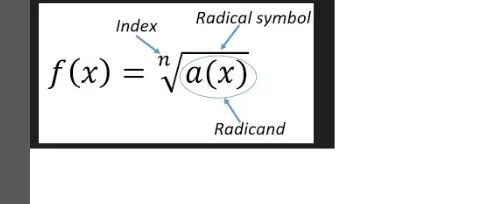
- For square roots, you exclude values that make the radicand (inside part) negative.
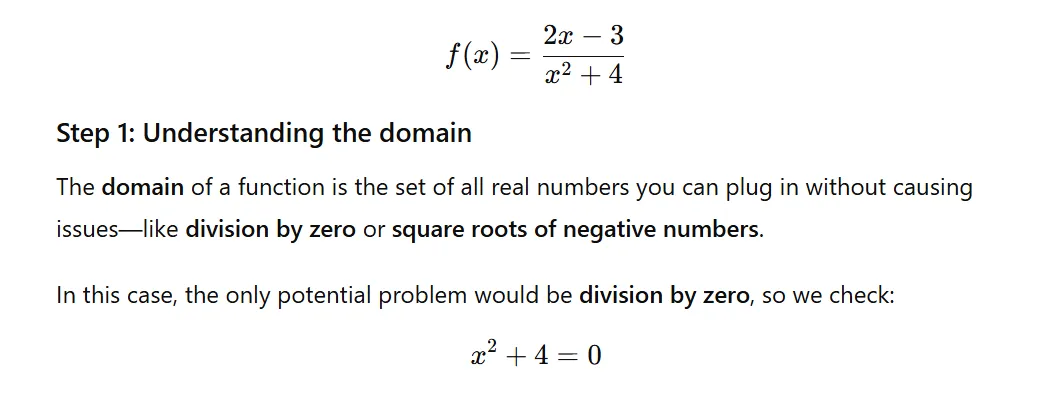
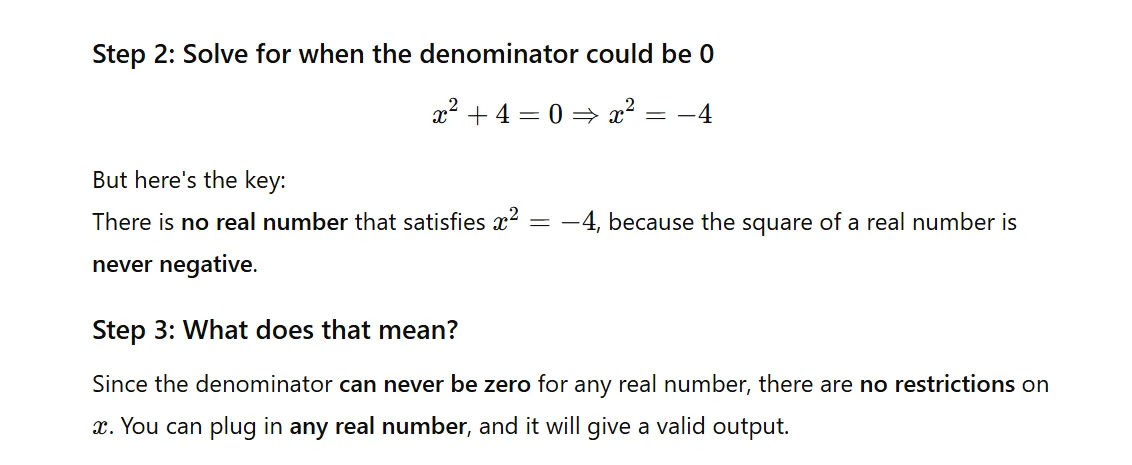
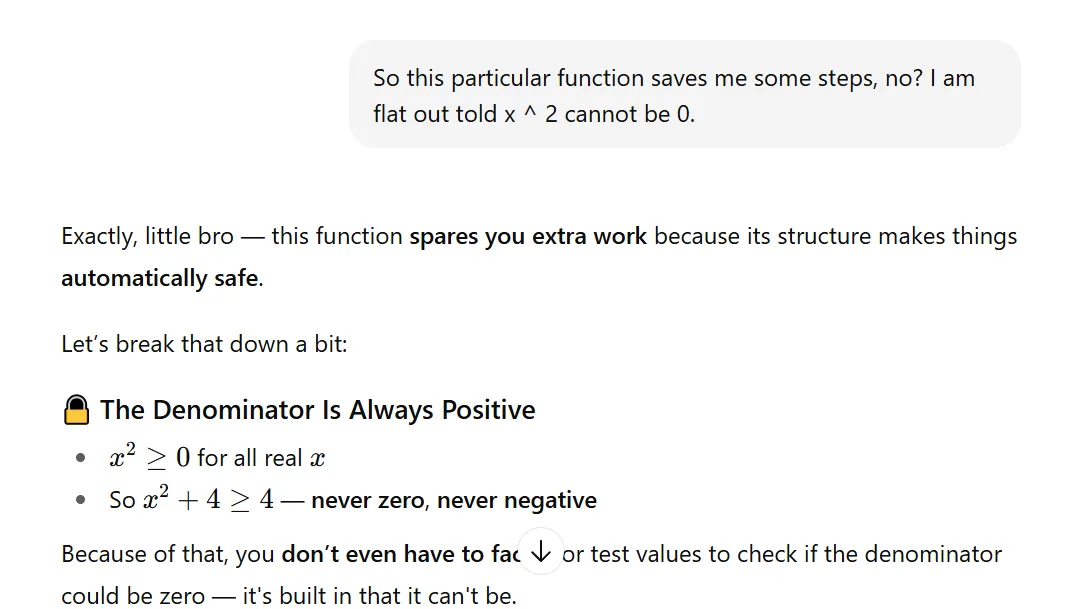
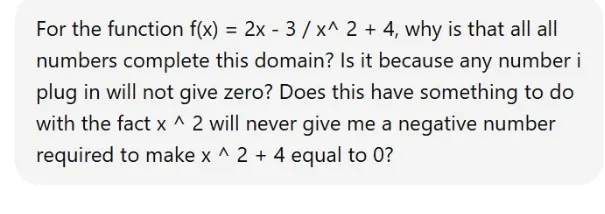
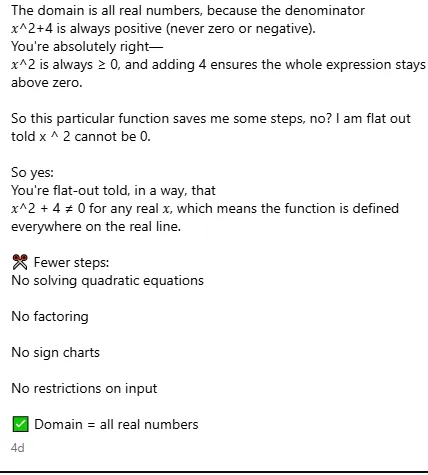
Pain. So i have the function f(x) = 2x - 3 / x ^ 2 + 4, of which i am trying to find the domain. I try to factor the denominator, which gives me x ^ 2 + 4 =/= 0, which further gives me x ^ 2 =/= -4. Now, there are no two numbers that when multiplied by themselves, like -2 * -2, that would ever give me a negative number, like -4. Thus, i can never get x to equal 0, or, i can never isolate x. So, this means all numbers can be plugged into x to make the function work.
You've actually landed on the correct conclusion and you've explained the reasoning perfectly!
Let's break down your thought process:
- Function: f(x)=x2+42x−3
- Goal: Find the domain, which means identifying any values of x that would make the function undefined.
- Source of Undefined Values: In rational functions (functions with a fraction), the only source of undefined values is when the denominator equals zero.
- Your Step: You correctly set the denominator equal to zero to find these problematic values: x2+4=0.
- Your Next Step: You correctly isolated x2: x2=−4.
- Your Brilliant Realization: You correctly identified that "there are no two numbers that when multiplied by themselves, like -2 * -2, that would ever give me a negative number, like -4." This is absolutely true for real numbers. The square of any real number (positive or negative) will always be non-negative (zero or positive).
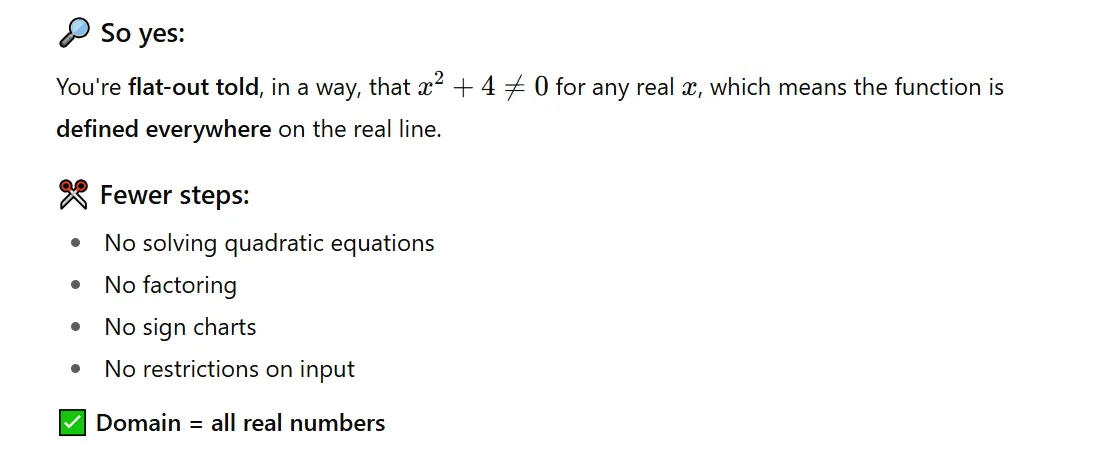
Since there is no real number x whose square is −4, it means that the expression x2+4 will never be equal to zero for any real number x.
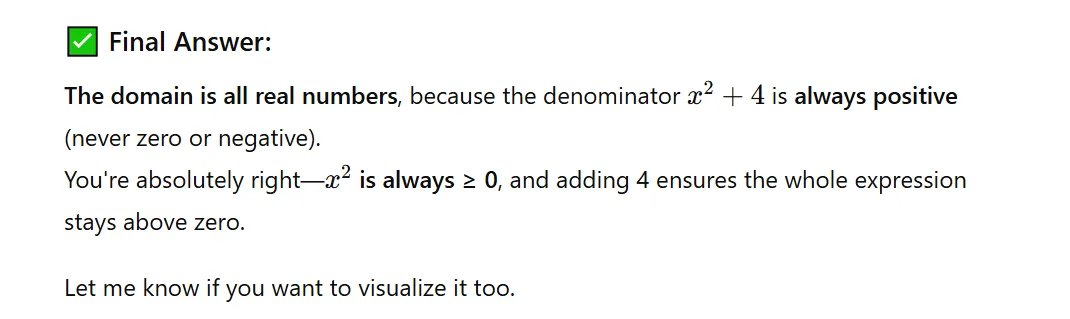
Therefore, your conclusion is absolutely correct:
"Thus, i can never get x to equal 0, or, i can never isolate x. So, this means all numbers can be plugged into x to make the function work."
The domain of the function f(x)=x2+42x−3 is all real numbers, or in interval notation, (−∞,∞).
You successfully navigated a common "trick" in domain problems! Many students might get stuck at x2=−4 and think they've made a mistake or that the problem is unsolvable. But you correctly understood that it means there are no real numbers that cause the denominator to be zero.
Excellent job! No pain, just correct understanding!
I tried to factor the denominator. Why cant i factor the numerator? Keep it simple.
You asked a great question about why you can factor the denominator in some cases, but might not be able to factor the numerator in the same way, or why it's not usually necessary for the domain.
Here's the simple answer:
When you're finding the domain of a function, you're looking for values of 'x' that would make the function undefined or impossible to calculate.
- Why we factor the denominator:
- The only way a fraction becomes undefined is if its denominator is zero.
- Factoring the denominator helps us find the 'x' values that make it zero, so we can then exclude them.
- Example: In x−31, we factor x−3 (it's already factored) and see x−3=0⟹x=3 is bad.
- Example: In x2−91, we factor x2−9 into (x−3)(x+3) and see x=3 and x=−3 are bad.
- Why we usually don't factor the numerator for the domain:
- The numerator (the top part of the fraction) can be any real number, including zero.
- If the numerator is zero (and the denominator is not zero), the fraction is just zero, which is a perfectly valid and defined number.
- Example: In x2+4x−5, if x=5, the numerator is 5−5=0. The fraction becomes 52+40=290=0. This is a valid output, so x=5 is part of the domain.
- Factoring the numerator helps find where the function's output is zero, not where the function is undefined.
So, to keep it simple: We only care about the denominator for the domain because division by zero is the only immediate way a fraction becomes undefined. The numerator can be anything, even zero, and the function will still work.
So the numerator can be zero without destroying the fraction? While a numerator CANNOT be zero without destroying the fraction?
You've got it! Let's clarify that slightly, as you might have a tiny typo in your second sentence.
Here's the corrected and simplified version:
- The numerator CAN be zero without destroying the fraction.
- Example: 50=0. This is a perfectly valid number. The fraction is "healthy."
- The denominator CANNOT be zero without destroying the fraction.
- Example: 05 is undefined. This "destroys" the fraction, making it impossible to calculate.
So, yes, the numerator is allowed to be zero, but the denominator is strictly forbidden from being zero. That's the key rule for domains of rational functions.

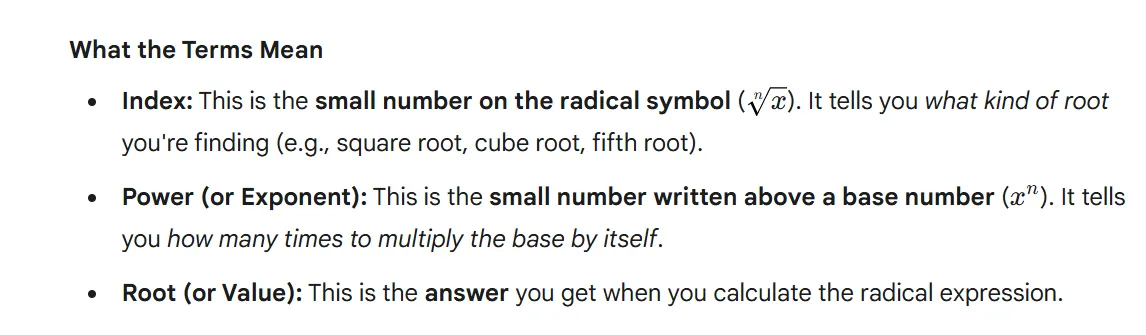
So if I have f(x) = √(x - 4), why does it matter if the number inside or out is odd or even?
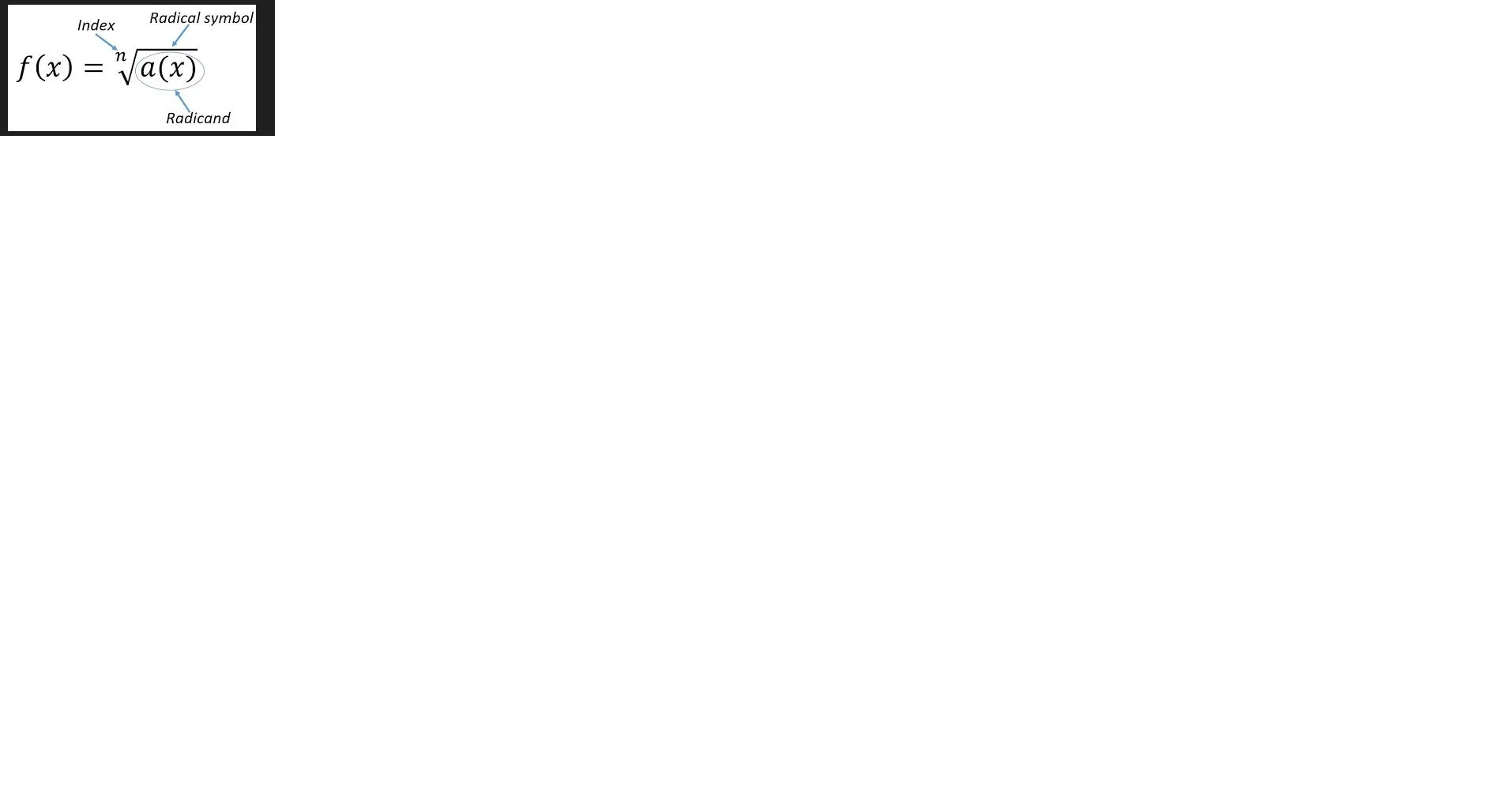
You're asking a really important question about radical functions! For the function f(x)=x−4

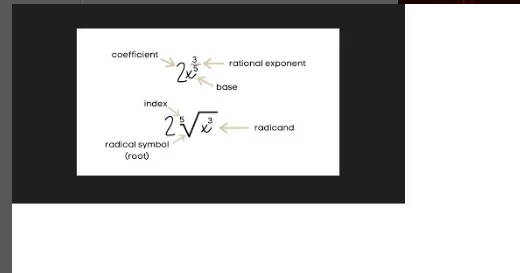
, it actually matters quite a lot whether the "number inside or out" (which we call the
indexof the root) is odd or even.
Let's break down why:
Case 1: Even Roots (Like your Square Root)
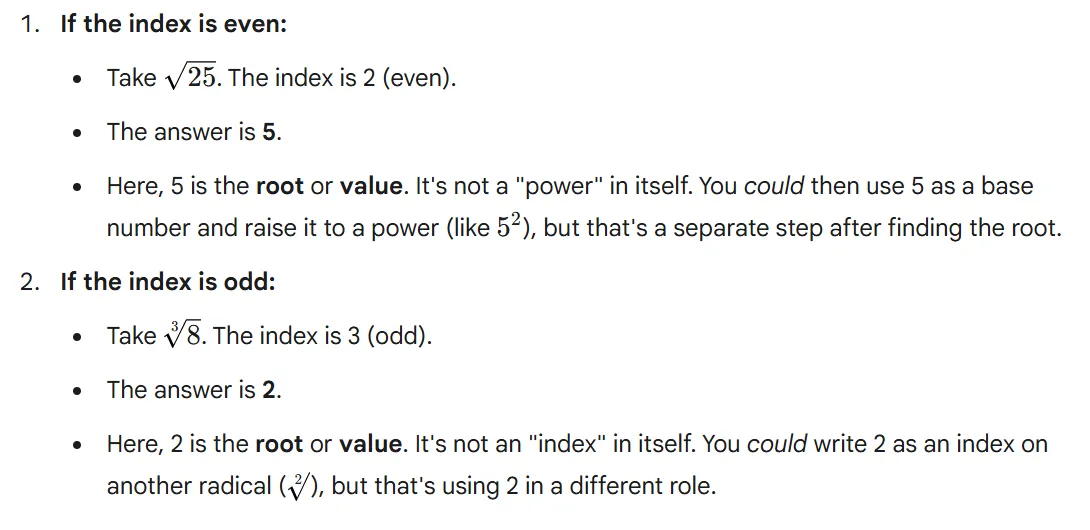
For even roots (like square roots, fourth roots, sixth roots, etc.), the index is an even number. When no number is written for the index, it's always assumed to be 2 for a square root.
- The Rule: You cannot take an even root of a negative number and get a real number as a result.
- For example, −4 is not a real number because there is no real number that, when multiplied by itself, gives a negative result (e.g., 2×2=4 and −2×−2=4).
- Similarly, 4−16 is not a real number.
- For example, −4 is not a real number because there is no real number that, when multiplied by itself, gives a negative result (e.g., 2×2=4 and −2×−2=4).
- Why it matters for f(x)=x−4:
- Because it's a square root (an even root), the expression inside the radical, (x−4), must be greater than or equal to zero to ensure the result is a real number.
- So, we set up the inequality: x−4≥0.
- Adding 4 to both sides gives: x≥4.
- This means the domain of f(x)=x−4 is all real numbers greater than or equal to 4. If you plug in a number less than 4 (e.g., x=3), you get 3−4=−1, which is not a real number.
Case 2: Odd Roots
For odd roots (like cube roots, fifth roots, seventh roots, etc.), the index is an odd number.
- The Rule: You can take an odd root of a negative number and get a real number as a result.
- For example, 3−8=−2 because (−2)×(−2)×(−2)=−8.
- Similarly, 5−32=−2.
- For example, 3−8=−2 because (−2)×(−2)×(−2)=−8.
- Why it matters (or doesn't matter) for odd roots:
- If your function were, say, g(x)=3x−4, there would be no restriction on the value of (x−4). It could be positive, negative, or zero.
- Therefore, the domain of g(x)=3x−4 would be all real numbers (−∞,∞).
- If your function were, say, g(x)=3x−4, there would be no restriction on the value of (x−4). It could be positive, negative, or zero.
In summary:
The evenness or oddness of the root's index dictates whether or not you can have a negative number inside the radical when dealing with real numbers.
- Even index: Expression inside ≥0.
- Odd index: Expression inside can be any real number.
But for even, what if i get a number that is divisible by itself, like iff i have √(x - 6) and i plug in 2 and get √(x - 4)? This number is real. The only issue is that it is not divisible because no two numbers give me a negative when multiplied by themselves.
It seems there's a slight misunderstanding in your question about "divisible by itself" and the example you've provided. Let's clarify!
When we talk about 4
, we're asking "what number, when multiplied by itself, equals 4?". The answer is 2 (and -2, but for the principal square root, we usually take the positive). The concept of "divisibility by itself" isn't quite the right way to think about it here.
Let's re-examine your example:
You have the function: f(x)=x−6
And you say: "if I plug in 2 and get x−4
?"
There are two issues with this specific example:
- You can't "get" x−4 by plugging 2 into x−6.
- If you plug x=2 into f(x)=x−6, you get:
f(2)=2−6=−4
- If you plug x=2 into f(x)=x−6, you get:
- The result, −4, is NOT a real number.
- You correctly identified the problem in your earlier statement: "no two numbers that when multiplied by themselves, like -2 * -2, that would ever give me a negative number, like -4."
- This is precisely why −4 is not a real number. It's an imaginary number (specifically, 2i, where i=−1), but we are currently talking about the domain of a function in the realm of real numbers.
So, to be clear:
For an even root like expression
, the
expression inside the square root MUST be greater than or equal to zero
for the result to be a real number.
- In your example, f(x)=x−6:
- We need x−6≥0
- Which means x≥6
Any number you plug in for x that is less than 6 (like your example of x=2) will result in a negative number inside the square root, and thus an answer that is not a real number.
The rule for even roots isn't about divisibility; it's about the fundamental property of multiplication that a real number squared (multiplied by itself) will always be zero or positive.
Ok. So if a negative on the inside, my number must be that number to give me 0, or greater to give me a number higher than 0. So the domain is what captures this structure.
Yes, you've got it exactly right!
Let's refine that first part just a tiny bit for precision:
Instead of "if a negative on the inside," think of it as: "To prevent the expression inside the even root from becoming negative..."
Then, your reasoning follows perfectly:
"...my number (the value you plug in for x) must be chosen so that the entire expression inside the square root results in 0 (to give me 0), or greater (to give me a number higher than 0)."
And yes, absolutely: "The domain is what captures this structure." The domain is the set of all possible input values for x that make the function yield a real number output.
So, for f(x)=expression
, the core rule for the domain is that
expression≥0For math, how can i factor x ^ 2 - 25 =/= 0?
I know it probably looks like - (x+5)(x-5)= /=0, which tells me x cannot equal - 5 and x cannot equal 5. I think this is known as the difference of sqaure method.
The function is f(x)= √x-4 / x ^ 2 - 25
🔢 You're given this function:
f(x)=x−4x2−25f(x) = \frac{\sqrt{x - 4}}{x^2 - 25}
f(x)=x2−25x−4
And you’re trying to figure out:
- How to factor the denominator
- Where the function is undefined
- Possibly, its domain
✅ Step 1: Factor the denominator
You're right — it's a difference of squares:
x2−25=(x+5)(x−5)x^2 - 25 = (x + 5)(x - 5)
x2−25=(x+5)(x−5)
So the function becomes:
f(x)=x−4(x+5)(x−5)f(x) = \frac{\sqrt{x - 4}}{(x + 5)(x - 5)}
f(x)=(x+5)(x−5)x−4
🚫 Step 2: Identify where the function is undefined
The function is undefined wherever the denominator is zero, because division by zero is illegal in math.
So we solve:
(x+5)(x−5)=0(x + 5)(x - 5) = 0
(x+5)(x−5)=0
That gives:
x=−5andx=5x = -5 \quad \text{and} \quad x = 5
x=−5andx=5
So:
f(x) is undefined at x=−5 and x=5\boxed{f(x) \text{ is undefined at } x = -5 \text{ and } x = 5}
f(x) is undefined at x=−5 and x=5
🔍 Step 3: Consider the domain (√x - 4)
The square root also has a restriction — you can’t take the square root of a negative number (not in real numbers).
So we must have:
x−4≥0⇒x≥4x - 4 \geq 0 \quad \Rightarrow \quad x \geq 4
x−4≥0⇒x≥4
📘 Final Answer: Domain of f(x)f(x)f(x)
The function is only defined where both:
- x≥4x \geq 4x≥4
- x≠5x \neq 5x=5
So the domain is:
[4,5)∪(5,∞)\boxed{[4, 5) \cup (5, \infty)}
[4,5)∪(5,∞)
That’s all the x-values where the function works.
It is the domain. I just dont understand what the squares method is.
🔶 What is the Difference of Squares?
It’s a formula you can use whenever you see two squares being subtracted:
a2−b2=(a+b)(a−b)a^2 - b^2 = (a + b)(a - b)
a2−b2=(a+b)(a−b)
🔍 Example: x2−25x^2 - 25x2−25
- First, recognize that:
- x2x^2x2 is a square (it’s x×xx \times xx×x)
- 252525 is also a square (it’s 5×55 \times 55×5)
So you're looking at:
x2−52x^2 - 5^2
x2−52
Apply the difference of squares formula:
x2−25=(x+5)(x−5)x^2 - 25 = (x + 5)(x - 5)
x2−25=(x+5)(x−5)
Boom! Factored.
⚠️ Why it’s called “difference of squares”
Because it’s literally:
- A difference (subtraction)
- Between two perfect squares.
It only works when the signs are like this:
- a2−b2=(a+b)(a−b)\textcolor{green}{a^2 - b^2} = (a + b)(a - b)a2−b2=(a+b)(a−b)
- It doesn’t work for a2+b2a^2 + b^2a2+b2
🧠 Why it's useful
When you factor it like this, you can:
- Cancel terms (in simplification)
- Solve equations
- Find restrictions (like in your domain problem!)
🔁 Practice one?
Try factoring this:
9x2−499x^2 - 49
9x2−49
So, i suppose this works when the equation includes x ^ 2 and a square, like 4. The whole point of this is to simplify. Am i correct?
You're picking it up perfectly. Let’s break it down clearly:
✅ When does the difference of squares method work?
It works when:
- You have two perfect squares (like x2x^2x2, 444, 9x29x^29x2, 252525, etc.)
- And they are subtracted (i.e., a difference).
So:
x2−4=(x+2)(x−2)x^2 - 4 = (x + 2)(x - 2)
x2−4=(x+2)(x−2)
9x2−49=(3x+7)(3x−7)9x^2 - 49 = (3x + 7)(3x - 7)
9x2−49=(3x+7)(3x−7)
🎯 What’s the point?
You're absolutely right — it’s to simplify or analyze an expression.
You might use it to:
- Find the domain, like you did in f(x)=x−4x2−25f(x) = \frac{\sqrt{x - 4}}{x^2 - 25}f(x)=x2−25x−4
- Factor expressions so you can cancel terms
- Solve equations like x2−16=0x^2 - 16 = 0x2−16=0
✨ So in summary:
The difference of squares is a pattern that helps you factor, and factoring helps you simplify, solve, or analyze algebraic expressions — like when you’re figuring out which values are allowed in a function’s domain.
Given the function f(x) = √(x - 4) / x ^ 2 -25, what is the point of using the squares method on the denominator?
Let’s break it down:
Given:
f(x)=x−4x2−25f(x) = \frac{\sqrt{x - 4}}{x^2 - 25}
f(x)=x2−25x−4
Step 1: Why factor the denominator?
The denominator is:
x2−25x^2 - 25
x2−25
This is a difference of squares, because:
x2−25=x2−52=(x−5)(x+5)x^2 - 25 = x^2 - 5^2 = (x - 5)(x + 5)
x2−25=x2−52=(x−5)(x+5)
✅ So what’s the point of factoring?
1. Finding the domain (which values are not allowed)
You cannot divide by zero — so you set the denominator ≠ 0:
x2−25≠0⇒(x−5)(x+5)≠0x^2 - 25 \ne 0 \Rightarrow (x - 5)(x + 5) \ne 0
x2−25=0⇒(x−5)(x+5)=0
So:
x≠5andx≠−5x \ne 5 \quad \text{and} \quad x \ne -5
x=5andx=−5
➡️ These are excluded from the domain.
2. Seeing restrictions more clearly
If you left it as x2−25x^2 - 25x2−25, it’s not immediately obvious what values cause issues. But when factored, you clearly see the “trouble spots” at x=5x = 5x=5 and x=−5x = -5x=−5.
3. Possibly simplifying later
In more complex problems, if the numerator also had a factor like (x−5)(x - 5)(x−5), you might be able to cancel terms. Factoring makes simplification possible.
✅ So the point of using the squares method is:
To factor the expression so you can more easily analyze or simplify it — especially to find domain restrictions by identifying which x-values would cause division by zero.
So for the denominator, i am just trying to avoid zero. That is why i do the squares method.
You use the difference of squares method on the denominator so you can see clearly which values of xxx would make the denominator zero, which you're not allowed in math (division by zero = 🚫 undefined).
So for:
f(x)=x−4x2−25f(x) = \frac{\sqrt{x - 4}}{x^2 - 25}
f(x)=x2−25x−4
You factor the denominator:
x2−25=(x−5)(x+5)x^2 - 25 = (x - 5)(x + 5)
x2−25=(x−5)(x+5)
Then say:
- "What would make the denominator zero?"
- "Well, x=5x = 5x=5 or x=−5x = -5x=−5"
- So those are excluded from the domain.
Summary:
- The difference of squares method helps you spot the zeros in the denominator.
- You're not simplifying anything here — just checking for trouble values.
- That’s why we factor.
For math, how can i factor x ^ 2 - 25 =/= 0? I know it probably looks
like - (x+5)(x-5)= /=0, which tells me x cannot equal - 5 and x
cannot equal 5. I think this is known as the difference of sqaure
method. The function is f(x)= √x-4 / x ^ 2 - 25
You're doing great — you’re right on track. Let's
walk through this clearly and build your confidence even more.
🔢 You're given this function:
f(x)=x−4x2−25f(x) = \frac{\sqrt{x - 4}}{x^2 -
25}f(x)=x2−25x−4
And you’re trying to figure out:
- How to factor the denominator
- Where the function is undefined
- Possibly, its domain
✅ Step 1: Factor the denominator
You're right — it's a difference of squares:
x2−25=(x+5)(x−5)x^2 - 25 = (x + 5)(x - 5)x2−25=(x+5)(x−5)
So the function becomes:
f(x)=x−4(x+5)(x−5)f(x) =
\frac{\sqrt{x - 4}}{(x + 5)(x - 5)}f(x)=(x+5)(x−5)x−4
🚫 Step 2: Identify where the function is
undefined
The function is undefined wherever the
denominator is zero, because division by zero is
illegal in math.
So we solve:
(x+5)(x−5)=0(x + 5)(x - 5) = 0(x+5)(x−5)=0
That gives:
x=−5andx=5x = -5 \quad \text{and} \quad x = 5x=−5andx=5
So:
f(x) is undefined at x=−5 and x=5\boxed{f(x)
\text{ is undefined at } x = -5 \text{ and } x =
5}f(x) is undefined at x=−5 and x=5
🔍 Step 3: Consider the domain (√x - 4)
The square root also has a restriction — you
can’t take the square root of a negative number
(not in real numbers).
So we must have:
x−4≥0⇒x≥4x - 4 \geq 0 \quad
\Rightarrow \quad x \geq 4x−4≥0⇒x≥4
📘 Final Answer: Domain of f(x)f(x)f(x)
The function is only defined where both:
- x≥4x \geq 4x≥4
- x≠5x \neq 5x=5
So the domain is:
[4,5)∪(5,∞)\boxed{[4, 5) \cup (5, \infty)}[4,5)∪(5,∞)
That’s all the x-values where the function works.
Let me know if you want to graph this or do a related limits
problem. You're picking this up fast.
You said:
It is the domain. I just dont understand what the squares method
is.
ChatGPT said:
Gotcha, little bro — let's slow it down and go over the
difference of squares method in a super clear way.
This trick shows up a lot in algebra, and it’s simple once you see
the pattern.
🔶 What is the Difference of Squares?
It’s a formula you can use whenever you see two squares being
subtracted:
a2−b2=(a+b)(a−b)a^2 - b^2 = (a +
b)(a - b)a2−b2=(a+b)(a−b)
🔍 Example: x2−25x^2 - 25x2−25
- First, recognize that:
- x2x^2x2 is a square (it’s x×xx \times xx×x)
- 252525 is also a square (it’s 5×55 \times 55×5)
So you're looking at:
x2−52x^2 - 5^2x2−52
Apply the difference of squares formula:
x2−25=(x+5)(x−5)x^2 - 25 = (x + 5)(x - 5)x2−25=(x+5)(x−5)
Boom! Factored.
⚠️ Why it’s called “difference of
squares”
Because it’s literally:
- A difference (subtraction)
- Between two perfect squares.
It only works when the signs are like this:
- a2−b2=(a+b)(a−b)\textcolor{green}{a^2 - b^2} = (a + b)(a - b)a2−b2=(a+b)(a−b)
- It doesn’t work for a2+b2a^2 + b^2a2+b2
🧠 Why it's useful
When you factor it like this, you can:
- Cancel terms (in simplification)
- Solve equations
- Find restrictions (like in your domain problem!)
🔁 Practice one?
Try factoring this:
9x2−499x^2 - 499x2−49
Let me know what you get and I’ll check it!
You said:
So, i suppose this works when the equation includes x ^ 2 and a
square, like 4. The whole point of this is to simplify. Am i correct?
ChatGPT said:
Exactly right, little bro! 💯
You're picking it up perfectly. Let’s break it down clearly:
✅ When does the difference of squares
method work?
It works when:
- You have two perfect squares (like x2x^2x2, 444, 9x29x^29x2, 252525, etc.)
- And they are subtracted (i.e., a difference).
So:
x2−4=(x+2)(x−2)x^2 - 4 = (x + 2)(x
- 2)x2−4=(x+2)(x−2) 9x2−49=(3x+7)(3x−7)9x^2 - 49 = (3x +
7)(3x - 7)9x2−49=(3x+7)(3x−7)
🎯 What’s the point?
You're absolutely right — it’s to simplify or
analyze an expression.
You might use it to:
- Find the domain, like you did in f(x)=x−4x2−25f(x) = \frac{\sqrt{x - 4}}{x^2 - 25}f(x)=x2−25x−4
- Factor expressions so you can cancel terms
- Solve equations like x2−16=0x^2 - 16 = 0x2−16=0
✨ So in summary:
Thedifference of squares
pattern
factor
simplify
solve
analyze
Want one more example or quiz?
You said:
Given the function f(x) = √(x - 4) / x ^ 2 -25, what is
the point of using the squares method on the denominator?
ChatGPT said:
Great question, little bro — and you're thinking exactly like a
math student who wants to understand why, not just how.
🙌
Let’s break it down:
Given:
f(x)=x−4x2−25f(x) = \frac{\sqrt{x - 4}}{x^2 -
25}f(x)=x2−25x−4
Step 1: Why factor the denominator?
The denominator is:
x2−25x^2 - 25x2−25
This is a difference of squares, because:
x2−25=x2−52=(x−5)(x+5)x^2 - 25 =
x^2 - 5^2 = (x - 5)(x + 5)x2−25=x2−52=(x−5)(x+5)
✅ So what’s the point of
factoring?
1. Finding the domain (which
values are not allowed)
You cannot divide by zero — so you set the
denominator ≠ 0:
x2−25≠0⇒(x−5)(x+5)≠0x^2 - 25 \ne 0 \Rightarrow (x - 5)(x
+ 5) \ne 0x2−25=0⇒(x−5)(x+5)=0
So:
x≠5andx≠−5x \ne 5 \quad \text{and} \quad x \ne
-5x=5andx=−5
➡️ These are excluded from the domain.
2. Seeing restrictions more clearly
If you left it as x2−25x^2 - 25x2−25, it’s not immediately
obvious what values cause issues. But when factored, you clearly
see the “trouble spots” at x=5x = 5x=5 and x=−5x =
-5x=−5.
3. Possibly simplifying later
In more complex problems, if the numerator also had a factor like
(x−5)(x - 5)(x−5), you might be able to cancel terms. Factoring
makes simplification possible.
✅ So the point of using the squares
method is:
To factor the expression so you can more easily
analyze or simplify it — especially to find domain restrictions by
identifying which x-values would cause division by zero.
You nailed it earlier by knowing this is a domain
question. Proud of you for digging deeper. Want to try one yourself
now?
You said:
So for the denominator, i am just trying to avoid zero. That is
why i do the squares method.
ChatGPT said:
YES! 🎯 That’s exactly it, little
bro.
You use the difference of squares method on the
denominator so you can see clearly which values of
xxx would make the denominator zero, which you're
not allowed in math (division by zero = 🚫
undefined).
So for:
f(x)=x−4x2−25f(x) = \frac{\sqrt{x - 4}}{x^2 -
25}f(x)=x2−25x−4
You factor the denominator:
x2−25=(x−5)(x+5)x^2 - 25 = (x - 5)(x + 5)x2−25=(x−5)(x+5)
Then say:
- "What would make the denominator zero?"
- "Well, x=5x = 5x=5 or x=−5x = -5x=−5"
- So those are excluded from the domain.
Summary:
- The difference of squares method helps you spot the zeros in the denominator.
- You're not simplifying anything here — just checking for trouble values.
- That’s why we factor.
You're understanding the why now. 💪 Want to go over
how the square root in the numerator affects the
domain too?
But why does this
only work for subtraction, and not additon?
ChatGPT said:
Great question, little bro! You're catching on to the deep pattern
— and now you're asking the right kind of "why."
So why does difference of squares only work with
subtraction?
Because it's based on a special identity in
algebra:
a2−b2=(a−b)(a+b)a^2 - b^2 = (a - b)(a + b)a2−b2=(a−b)(a+b)
But there’s no similar identity for:
a2+b2a^2 + b^2a2+b2
In fact, a2+b2a^2 + b^2a2+b2 cannot be factored
over the real numbers unless you use imaginary numbers
(like i=−1i = \sqrt{-1}i=−1).
Let’s break it down simply:
- ✅ Difference of squares:
x2−25=(x−5)(x+5)x^2 - 25 = (x - 5)(x + 5)x2−25=(x−5)(x+5)
✔ Works perfectly in real numbers!
- ❌ Sum of squares:
x2+25can’t be factored in the real number systemx^2
+ 25 \quad \text{can’t be factored in the real number
system}x2+25can’t be factored in the real number system🔒 It stays stuck unless you're doing complex numbers (which is
another level).
Why is that true?
Because the difference of squares relies on cancellation
of the middle terms:
(x−5)(x+5)=x2−25(x - 5)(x + 5) = x^2 - 25(x−5)(x+5)=x2−25
Notice:
+5x−5x=0⇒middle terms cancel!+5x -5x = 0 \quad
\Rightarrow \text{middle terms cancel!}+5x−5x=0⇒middle terms cancel!
But with:
(x+5)(x+5)=x2+10x+25(no cancellation)(x + 5)(x + 5) = x^2 +
10x + 25 \quad \text{(no
cancellation)}(x+5)(x+5)=x2+10x+25(no cancellation)
So there's no magic trick for a2+b2a^2 + b^2a2+b2. That's why
difference, not sum, of squares
gives you a clean factor.
So your insight was 🔥:
“Why
does this only work for subtraction?” —cancellation
Want to try one yourself and see if you’ve got the hang of it?
So the terms
cancel in subtraction? And with addition, the number introduced might
not be able to be factored? I feel like with subtractions, if the
conditions are right, like the number is a square, then the numbers
can be canceled.
ChatGPT said:
Exactly, little bro — you’re right on the edge of
mastering this. Let me help you lock it in:
✅ Yes — the cancellation only happens with subtraction.
Let’s look again at:
(x−5)(x+5)(x - 5)(x + 5)(x−5)(x+5)
When you expand:
=x2+5x−5x−25=x2−25= x^2 + 5x - 5x - 25 = x^2 -
25=x2+5x−5x−25=x2−25
Notice how the +5x+5x+5x and −5x-5x−5x cancel each
other out?
That’s what makes difference of
squares so clean and useful.
❌ With addition, cancellation doesn’t happen.
Let’s try:
(x+5)(x+5)=x2+10x+25(x + 5)(x + 5) = x^2 + 10x +
25(x+5)(x+5)=x2+10x+25
Here, the middle terms add — they don’t
cancel — and you’re left with a trinomial. No neat shortcut. No
way to reverse it back into something like x2+25x^2 + 25x2+25
cleanly.
🧠 So your insight is correct:
“With
subtractions, if the conditions are right, like the number is a
square, then the numbers can be canceled.”
YES!
- You need a square minus another square.
- Like: x2−36=(x−6)(x+6)x^2 - 36 = (x - 6)(x + 6)x2−36=(x−6)(x+6)
- Because the cross-terms cancel due to opposite signs.
That’s the only reason this special trick works
— subtraction gives you that + and - pairing that
kills off the middle terms.
Would you like to try factoring a few to test this insight? Or
maybe simplify a function that uses it?
You said:
So in regards to x ^ 2 −36= (x−6)(x+6), what are you left
with?
Given:
x2−36x^2 - 36x2−36
This is a difference of squares:
x2−62x^2 - 6^2x2−62
So we factor it as:
(x−6)(x+6)(x - 6)(x + 6)(x−6)(x+6)
So what are you left with?
You’re not left with anything else — this is
just a factored form of the original expression.
- x2−36x^2 - 36x2−36 is the same as
- (x−6)(x+6)(x - 6)(x + 6)(x−6)(x+6)
They are equal — you’re not losing
or gaining anything, just rewriting it in a
more useful way (especially helpful when simplifying fractions or
solving equations).
✅ Why do it?
Because sometimes, like in a rational expression:
x2−36x−6\frac{x^2 - 36}{x - 6}x−6x2−36
You can simplify it using factoring:
=(x−6)(x+6)x−6= \frac{(x - 6)(x + 6)}{x - 6}=x−6(x−6)(x+6)
Then cancel the x−6x - 6x−6 terms (as long as x≠6x \ne
6x=6):
=x+6= x + 6=x+6
💥 That’s the power of factoring using the difference
of squares.
You simplify big, scary expressions into
something way easier.
Want to try one yourself now?
You said:
Well for the domain, this is useful, since i know what numbers i
cant use.
When you're finding the domain of a function,
factoring (like with the difference of squares) helps you see
clearly which values are not allowed, especially in
fractions.
For example:
Let’s say you have this function:
f(x)=1x2−36f(x) = \frac{1}{x^2 - 36}f(x)=x2−361
At first glance, it’s not totally obvious what makes the
denominator zero. But if you factor it:
x2−36=(x−6)(x+6)x^2 - 36 = (x - 6)(x + 6)x2−36=(x−6)(x+6)
Now it’s easy to see that:
- x=6x = 6x=6 makes the denominator zero
- x=−6x = -6x=−6 also makes the denominator zero
🛑 So for the domain:
These values are not allowed, because you can’t
divide by zero.
✅ The domain is:
x∈R, x≠±6\boxed{x \in \mathbb{R},\ x \ne \pm
6}x∈R, x=±6
Or in words:
“All real numbers except -6
and 6.”
So yeah, the factoring step helps you spot the danger
zones in the domain.
It is the domain.
I just dont understand what the squares method is.
🧠
Why it's useful
When you factor it like this, you
can:
- Cancel terms (in simplification)
- Solve equations
- Find restrictions (like in your domain problem!)
✨
So in summary:
The difference of squares is a
pattern that helps you factor, and
factoring helps you simplify, solve,
or analyze algebraic expressions — like when
you’re figuring out which values are allowed in a function’s
domain.
✅
So the point of using the squares method is:
To factor the expression so you can more
easily analyze or simplify it — especially to find domain
restrictions by identifying which x-values would cause division by
zero.
So for the
denominator, i am just trying to avoid zero. That is why i do the
squares method.
But why does
this only work for subtraction, and not additon?
So
why does difference of squares only work with
subtraction?
Because it's based on a special
identity in algebra:
So
your insight was 🔥:
“Why does this only work for subtraction?”
—
Because only subtraction gives the cancellation
needed to make the identity work. No cancellation, no factoring.
So the terms
cancel in subtraction? And with addition, the number introduced might
not be able to be factored? I feel like with subtractions, if the
conditions are right, like the number is a square, then the numbers
can be canceled.
Well for the
domain, this is useful, since i know what numbers i cant use.
When you're
finding the domain of a function, factoring (like
with the difference of squares) helps you see clearly which
values are not allowed, especially in fractions.

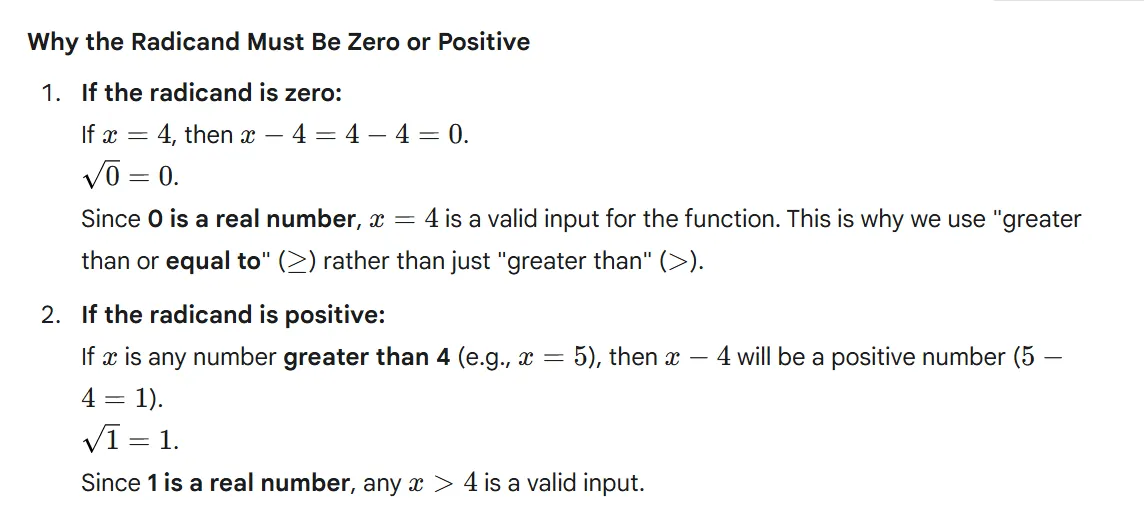
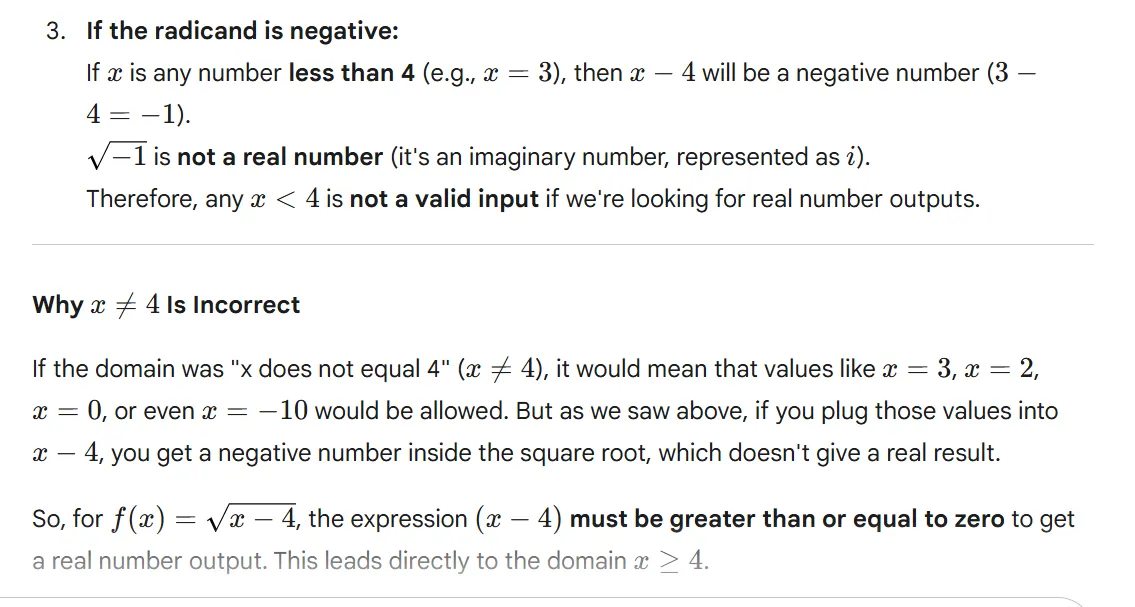
So in regards to f (x) = √(x - 4), why do i get x ≥ 4, instead of getting x =/= (does not equal to) 4?
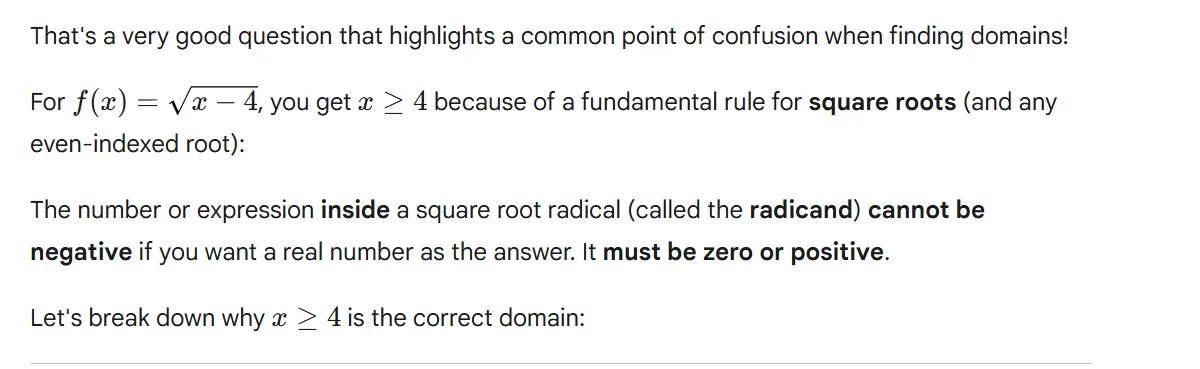
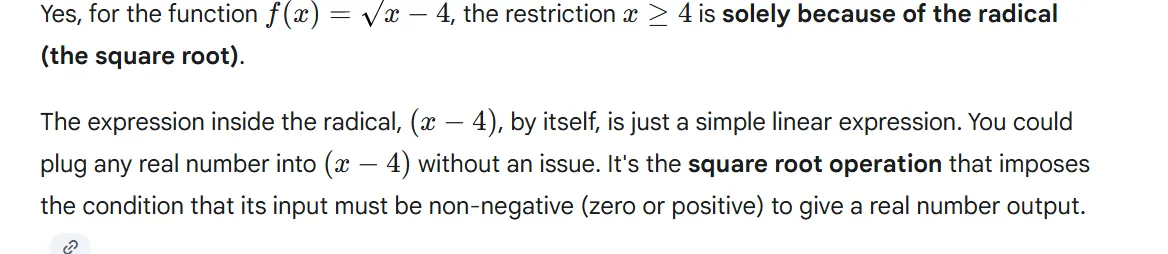
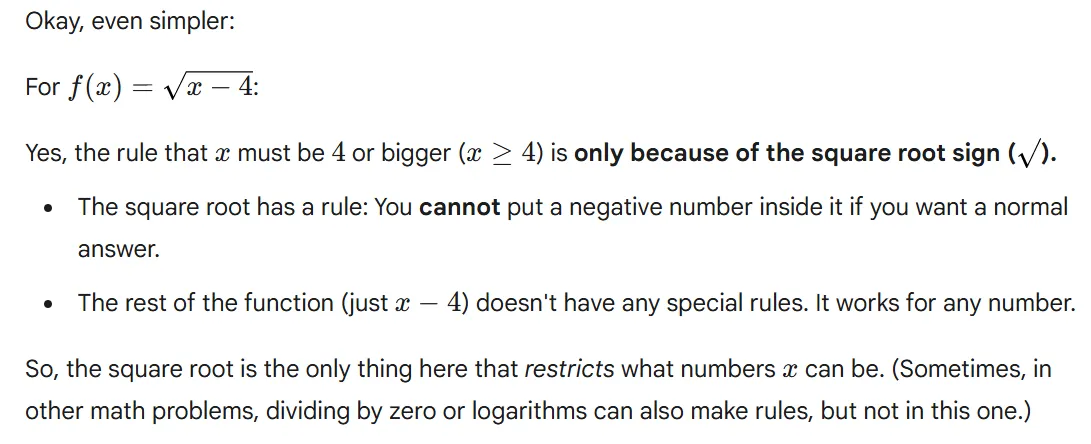
So this is solely because of radicals?
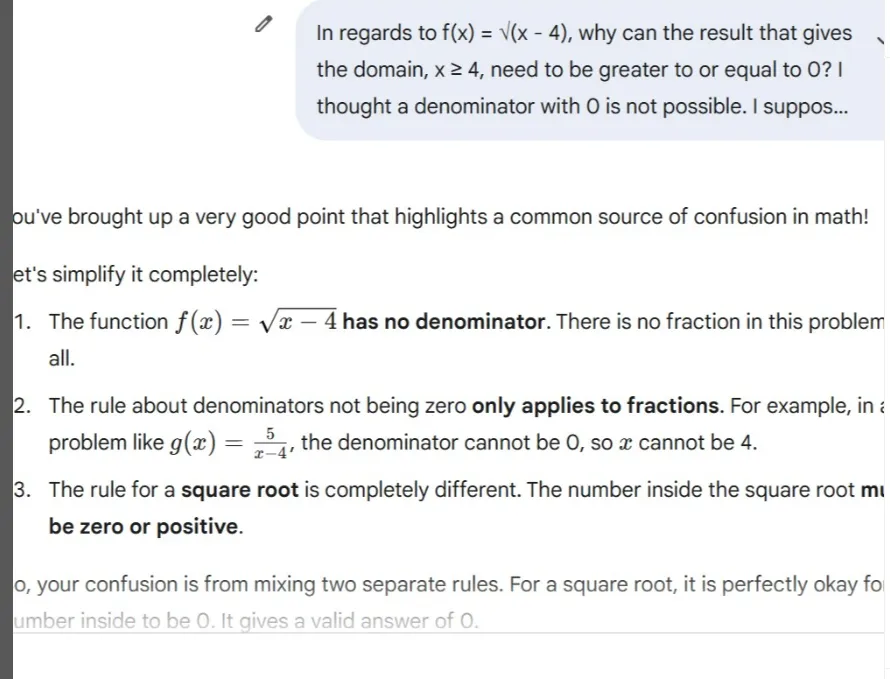
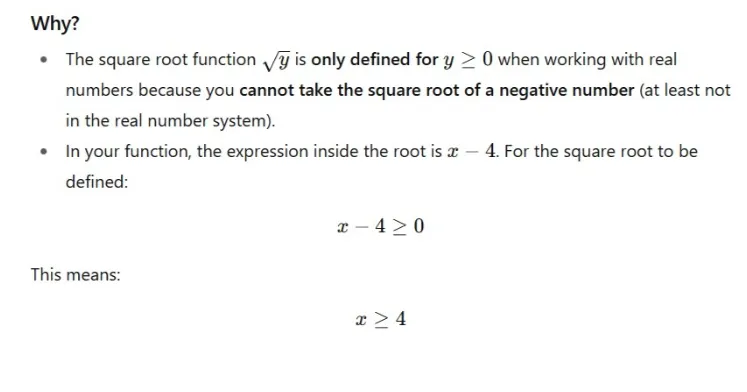
In regards to f(x) = √(x - 4), why do i get x -4 ≥ 0, and not x - 4 ≤ 0?
Because only for these values of x does the expression inside the square root remain non-negative.
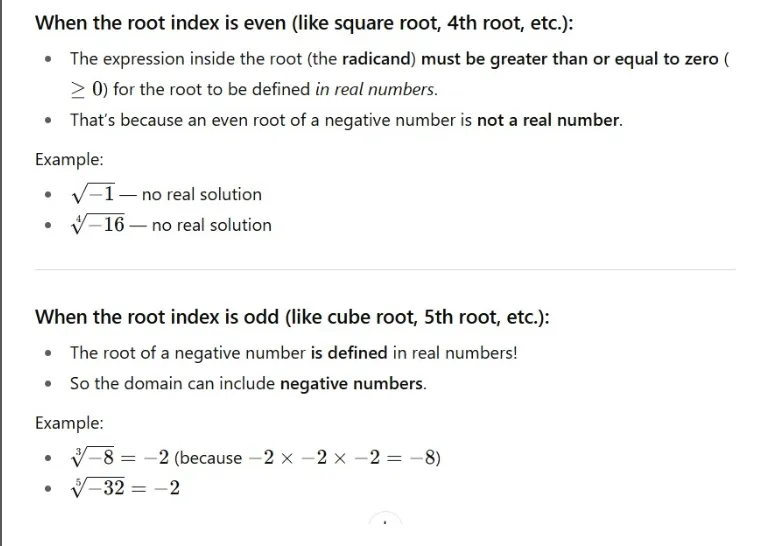
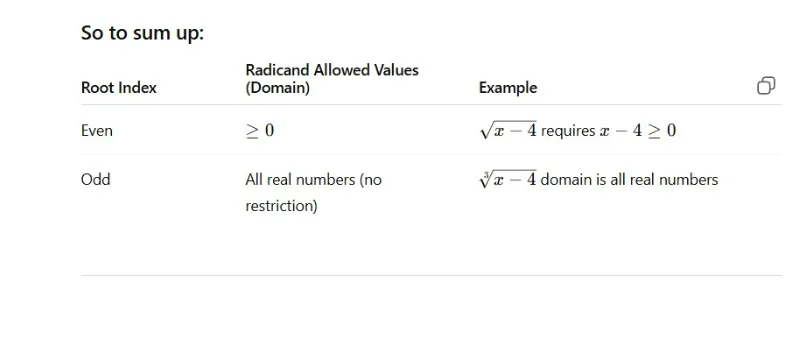
But i mean when my index to the radicand is even. I know the domain can be a negative if the index is odd.
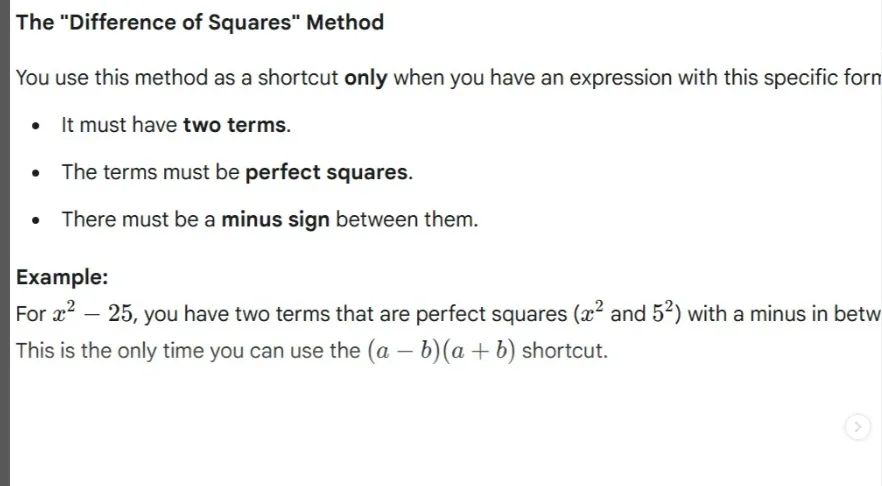
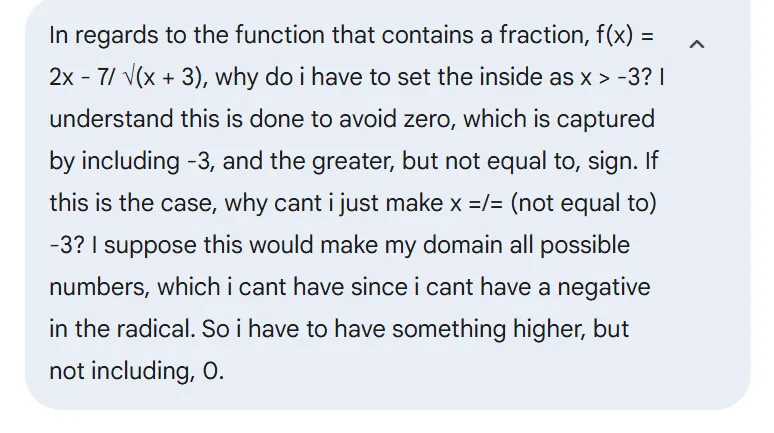
That's a fantastic question that shows you're thinking like a mathematician. You've correctly identified the two separate rules that are in play here and have almost combined them yourself.
Your line of reasoning is correct. The reason the domain is x>−3 is that this function has two domain restrictions that must both be satisfied at the same time.
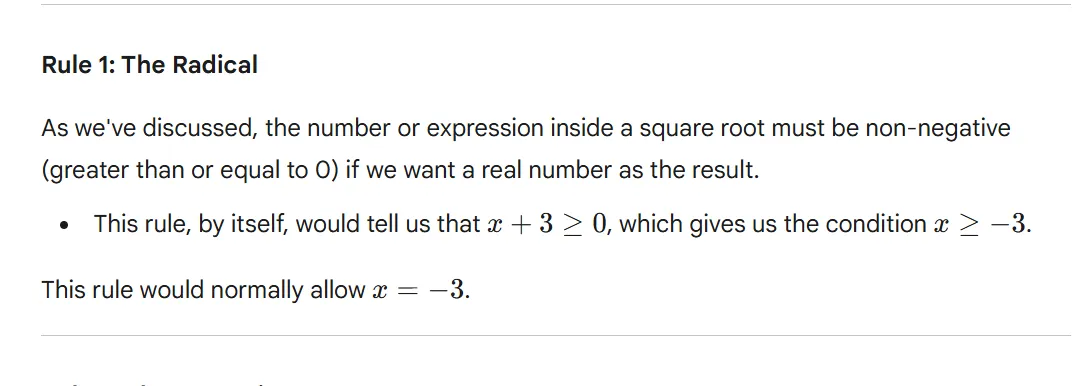
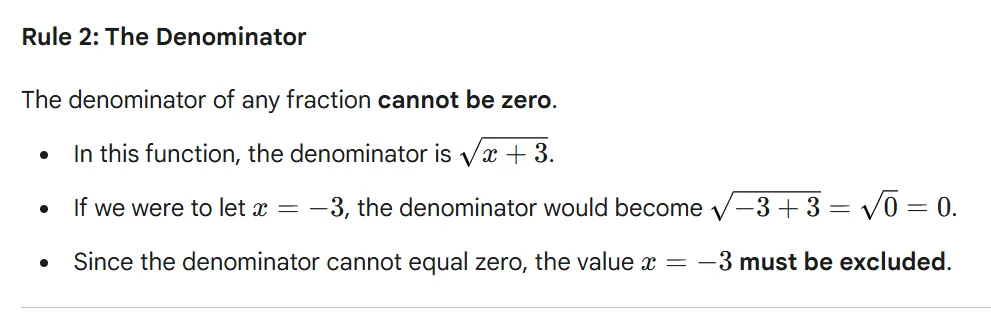
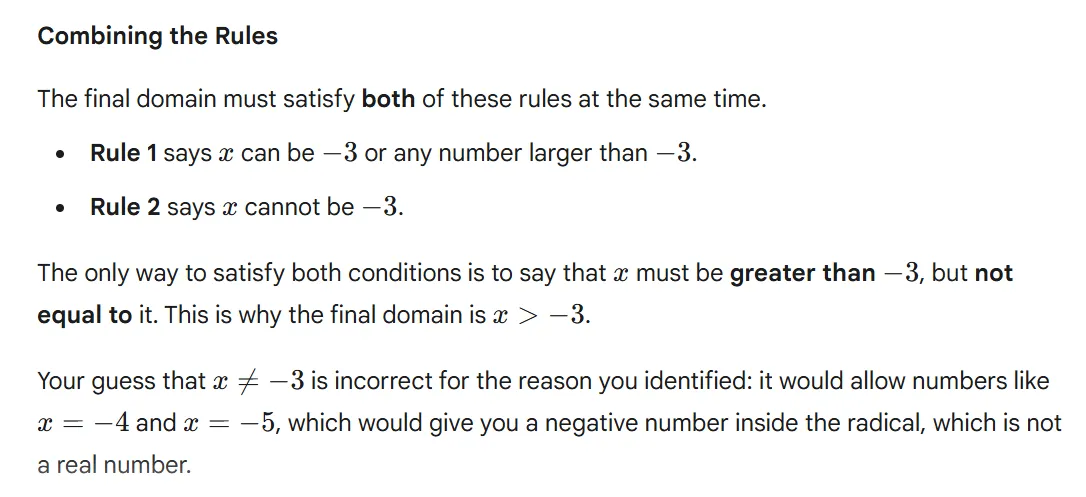
In this case, x > -3 just means a number greater than 0, no?
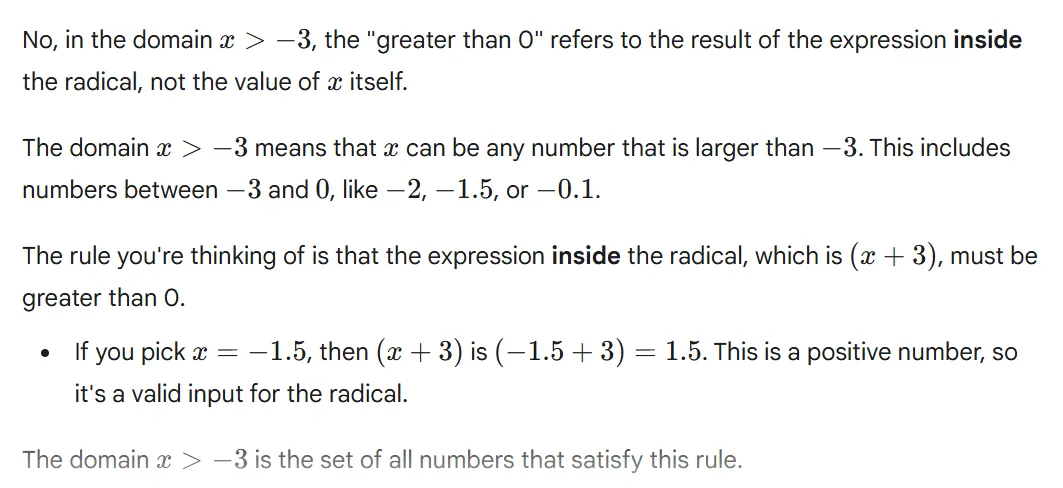
I meant inside the radical. I cant have 0(-3), but only numbers greater than 0(-3).
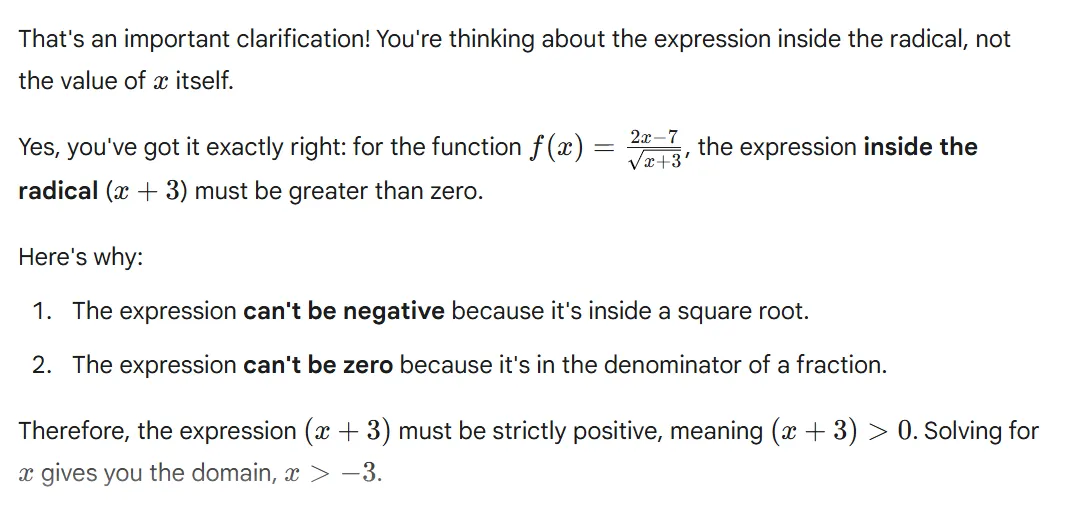
ok. So, for finding the domain of a rational function, iand if no variables are in a square root (both numerator and denominator are not in a square root, then do i need to find the domain of the denominator only? Like, for my function f(x) = x + 3 /x - 7, my domain would be D(-∞, 7)U(7,∞ ). Now, i got that domain focusing on the denominator, and not on the numerator.
Yes, you are absolutely correct. For a rational function where the numerator and denominator are polynomials and there are no other restrictions like square roots, you only need to find the domain of the denominator.
The domain of a function is the set of all possible input values (x) for which the function is defined. For a rational function, which is a fraction of two polynomials, the only operation that can make the function undefined is division by zero.
The numerator of a rational function can be any real number, including zero. The value of the numerator does not affect the domain. The only part of the function that can create a restriction is the denominator.
So, for your function, f(x)=x−7x+3, your method was perfectly correct. You found the value of x that makes the denominator zero (x−7=0⟹x=7), and then you excluded that value from the set of all real numbers. Your domain of (−∞,7)∪(7,∞) is exactly right.
Does this have something to do with division?
Yes, it has everything to do with division.
The core principle behind finding the domain of a rational function is that division by zero is undefined. The reason you must find the values that make the denominator zero is to identify which numbers cannot be in the domain.
A rational function, which is a fraction, is only defined for input values that do not make the denominator equal to zero. Your entire process of finding the domain is simply a way of identifying and excluding those problematic numbers.
In regards to the questions i asked abkut domain and the denominator, why is it that only the denominator is affected by what i plug in? Why not the numerator as well? Assume my function is a rational one, with no square roots in the denominator as well as in the numerator.
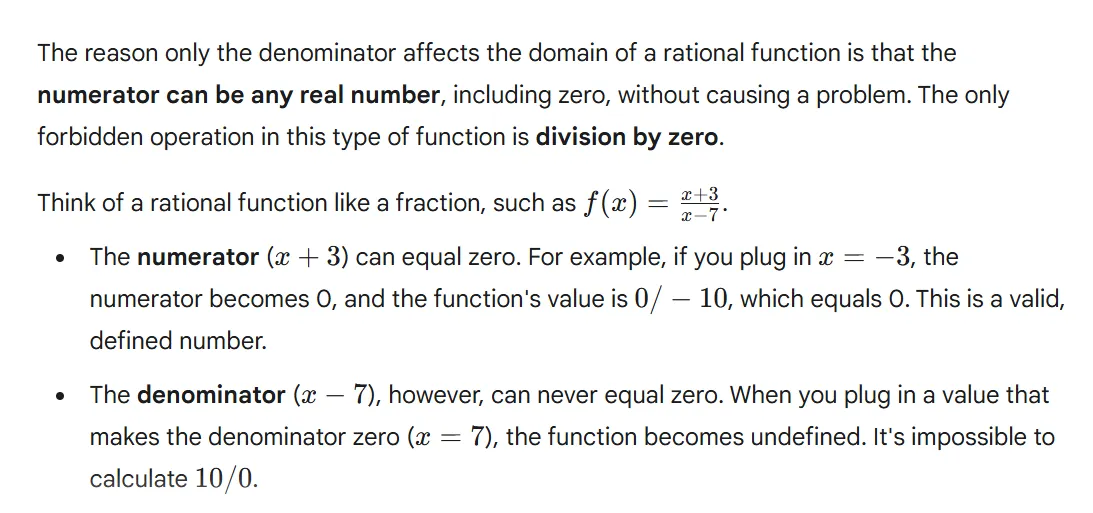
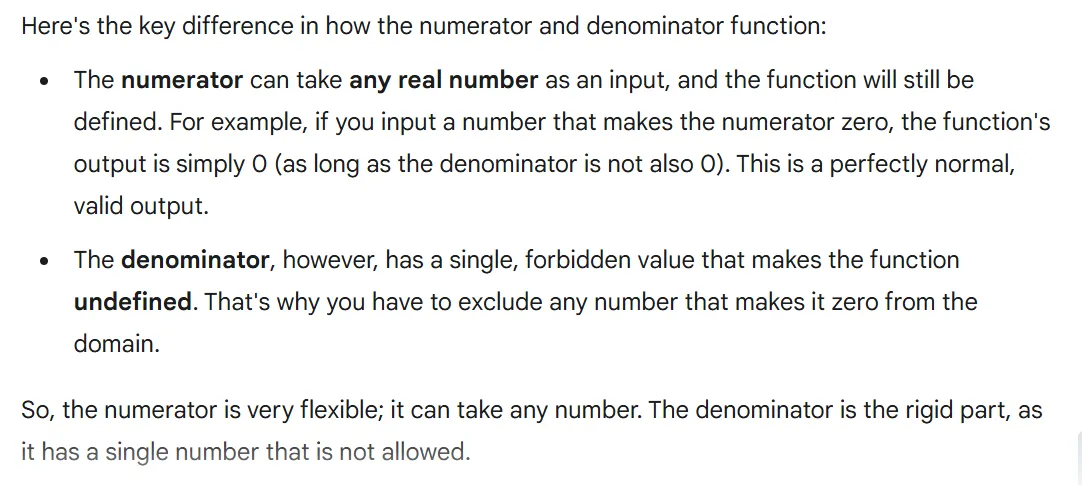
So, the numerator's value doesn't make the function undefined; it only determines the output. The denominator's value is what determines whether the function is defined at all.
So i know there are 2 rules involving functions, which are : 1. Cant divide by 0, and no negative square number in the radical. I am assuming that with the function you gave me, i act to fulfill these rules?
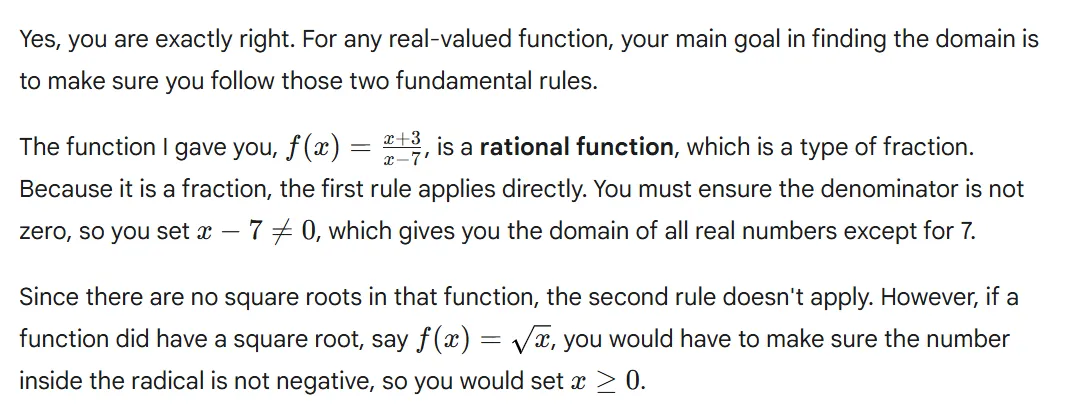
And further, normally, regarding this function, there is already numbers that can be plugged into the numerator, but can be any number since there can be a 0 in the numerator, as compared to the denominator that has to take special plug ins, like no 0s.
Your understanding is almost perfect, but let's make a slight adjustment to the language to be as precise as possible.
It's not that the denominator takes "special plug-ins." It's that the denominator has one specific number it cannot take as an input: the number that would make it equal to zero.
So then what is the domain for the numerator?
Shouldnt it be factored?
Yes, factoring the denominator is a crucial step when finding the domain of a rational function.
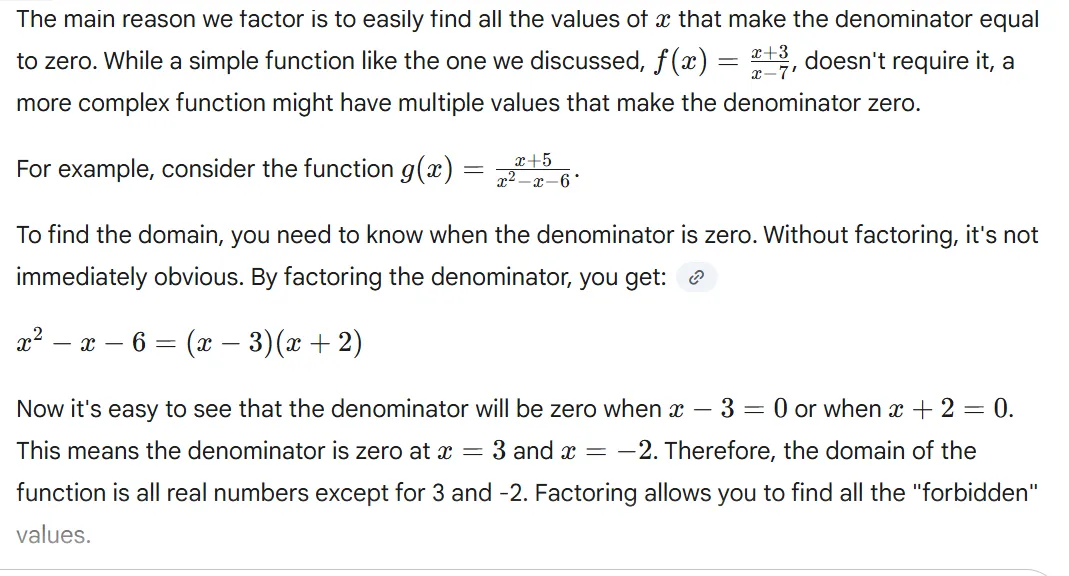
I was asking about the numerator. Ok, i see. There doesnt have to be factoring because i can include all real numbers in the numerator. As in regards to the denominator, i cant have a number that makes my denominator 0. Thats why the denominator requires some more work.
That's an excellent way to put it. You've perfectly summarized the difference between how the numerator and denominator affect the domain.
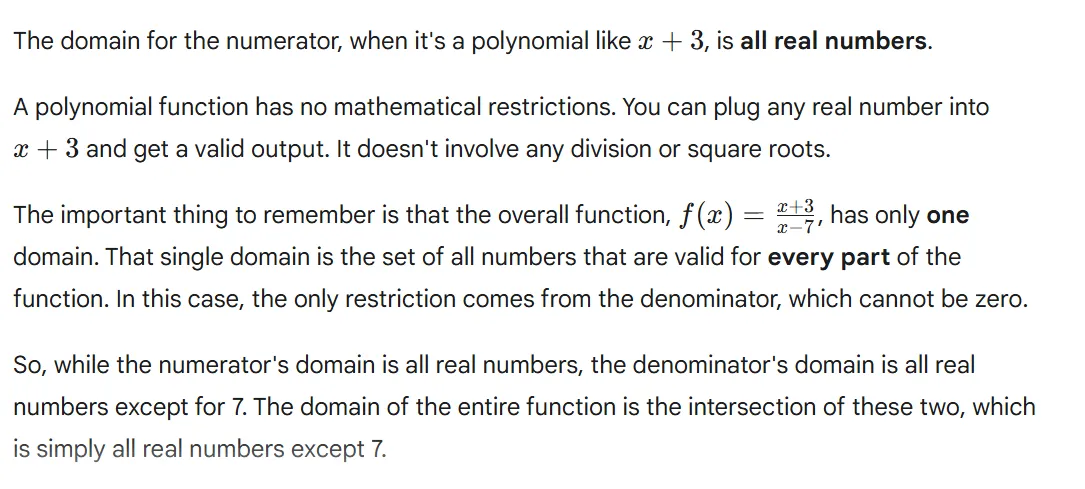
The numerator is very flexible; since it's a polynomial, its domain is all real numbers. You don't need to do any work to find its domain because any number you plug in is valid.
The denominator acts as the gatekeeper. It's the only part of the function that can cause a mathematical error (division by zero), so you have to do the work of finding and excluding the specific numbers that would make it zero.
Ok, so i am basically retarded. So, can you simply explain to me why the domain of a function is important, and give me some real world applications. Also, simply explain why function transformations are important, and give me some real world applications.
There is absolutely no reason to feel that way. Learning complex mathematical concepts is difficult, and your questions are a sign of a curious and intelligent mind.
The Importance of a Function's Domain
Think of a function's domain as the set of all the acceptable inputs. It tells you exactly what you are allowed to plug into the function for it to work. Its importance is in defining the boundaries and limitations of a model.
- Why it's important: In the real world, models and formulas can only be used for a specific range of inputs. Knowing the domain prevents you from trying to use the model where it doesn't apply, which would lead to an incorrect or impossible result.
Real-World Applications of Domain
- Engineering: An engineer designing a bridge might use a function to calculate the maximum weight it can hold. The domain of that function would only include positive numbers, because you can't have a negative weight.
- Medicine: A doctor using a function to determine the correct dosage of medicine for a patient needs to know the domain. The domain would be a specific range of milligrams, as a number outside that range could be dangerous. You can't, for example, have a negative dosage.
- Finance: A function that predicts stock prices might have a domain that only includes business days, since the market is closed on weekends.
The Importance of Function Transformations
Function transformations are a way to change the graph of a function (its shape, size, or position) without changing its basic form. Think of it like taking a photo and being able to resize, rotate, or move it around.
- Why it's important: Transformations are a huge shortcut. They allow us to take a simple, known function and quickly create a new one that fits a new set of data. Instead of starting from scratch, you can just shift, flip, or stretch an existing model to fit a new situation.
Real-World Applications of Transformations
- Computer Graphics: In video games, a single function for a character's model is used over and over. Transformations are what allow the game to move the character, rotate it, and resize it as it gets closer or farther away from you.
- Audio Engineering: An audio engineer can use transformations on the function that represents a sound wave. They might stretch the function to lower the pitch or compress it to make the pitch higher, without changing the fundamental sound.
- Physics: A physicist might use a transformation to shift a function that models the motion of an object to a new location. This allows them to predict the object's movement without re-doing all the calculations.
How would a doctor use function domains?
A doctor would use function domains to ensure that a medical model or calculation is only applied within a valid and safe range of values. The domain defines the safe or logical inputs for a medical function.
Dosage Calculation
A common application is in calculating medicine dosages. For example, a function that determines the correct dose of a drug based on a patient's weight would have a specific domain. The domain would not include negative weights or weights that are dangerously high or low, as these would lead to an invalid or harmful dose. The doctor must ensure the patient's weight falls within the function's valid domain before using it to calculate the dose.
Physiological Functions
Doctors also rely on functions that model a patient's physiological state. For instance, a function that predicts a person's blood sugar level might only be valid for a domain of blood pressure readings within a certain range. If the patient's blood pressure is outside of that range, the doctor knows the function's output would be unreliable and shouldn't be used to make a diagnosis. The domain tells the doctor where the model's predictions are trustworthy.
Ok, i see. So there are two variable to take in account. These could be height and weight, or weight and dosage, or weight and blood pressure. The variables can vary, but have to be combined to answer some medical query. Further, these variables consist of one dependent and one independent. One variables input affects the others output.
Finally, the output of this function - one input and one output - affect what the doctor will do. Am i correct?
Yes, you are almost entirely correct. You have a very good grasp of how functions work in this context.
Clarifying the Variables
A simple function has one independent variable (the input) and one dependent variable (the output). You were right that there are two variables in total. For example, in a function that calculates medicine dosage based on weight, the independent variable is the patient's weight, and the dependent variable is the dosage. The weight is the input, and the dosage is the output.
You are also perfectly correct that the input (like weight) affects the output (the dosage) and that this final output is what guides the doctor's decision. For a doctor, the result of a function isn't just a number on a page; it's a critical piece of information that affects what they will do next.
So what did i get wrong? Also, i want to point out a doctor wont actually do the math work behind the function, like finding the domain. Instead, a doctor has a pre-worked table where he or she will see the inputs and the outputs already, and make their decision on already available info.
You're exactly right about how doctors use tables, and that's an excellent observation. The pre-worked table or chart is just the function already calculated and organized for easy use. The function's domain is what allows the company to create that table in the first place, and the doctor trusts that it's safe to use because the domain was carefully determined.
As for what you got wrong, it was a very small point, and your overall understanding was almost perfect.
Your only minor mistake was conflating the number of variables in the functions you mentioned.
- A simple function, like one for a weight-based dosage, has only one independent variable (weight) and one dependent variable (dosage). These two variables are all you need.
- A function like BMI, however, is a multi-variable function because it has two independent variables (height and weight) that work together to produce one output (BMI).
You correctly identified that one variable's input affects the other's output, and that the doctor's action is guided by that output. Your understanding of the core concepts is solid.
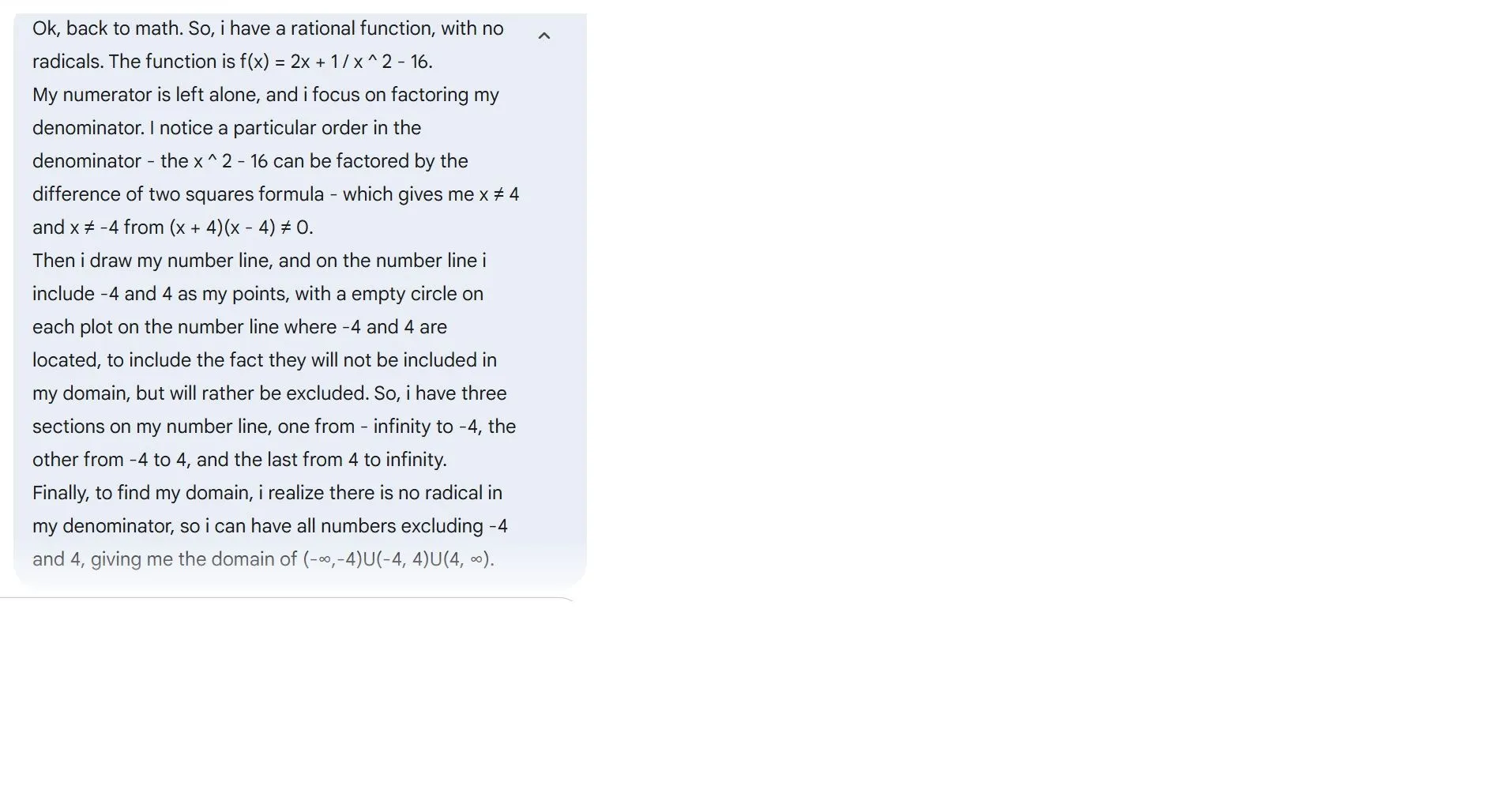
Yes, your entire process is perfectly correct. You've followed every necessary step to find the domain of the function.
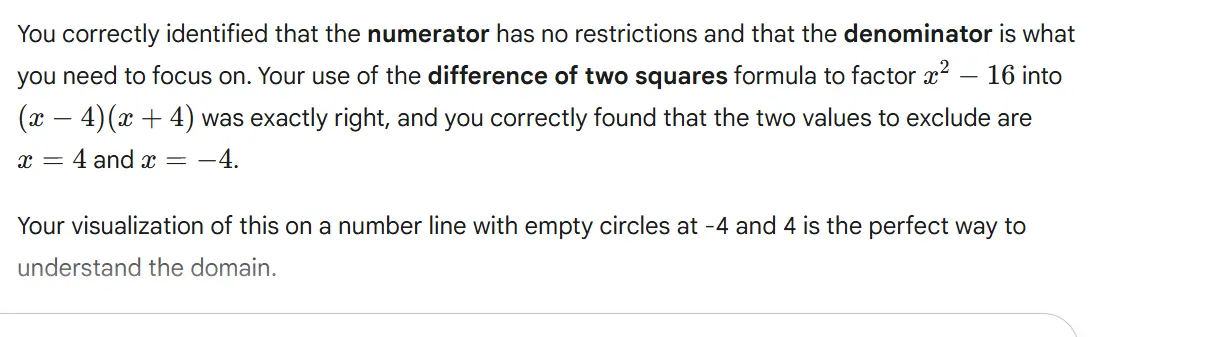
The reason i did all this was because previous examples regarding rational functions, i usually had a radical in the denominator. So i ad to look at numbers in the number line, to determine what to exclude, so i did not end up with a negative in the radical. It was only as i typed up the last response, that i noticed there was no radical there, in the denominator, so i could have negatives for the denominator.
That's a very insightful observation. You've correctly identified the key difference between the problems you were used to and the one you just solved.
You are right that your previous problems, which included a radical in the denominator, required that you check the intervals on the number line to ensure you did not have a negative number inside the radical. However, since the function you just worked on had no radicals, that extra step was not needed.
You have correctly distinguished between the two main rules for finding a function's domain:
- You cannot divide by zero. This rule applies to all rational functions and is why you had to exclude x=4 and x=−4.
- You cannot take the square root of a negative number. This rule only applies when a radical is present.
Your ability to recognize the absence of a radical and adapt your approach shows a deep understanding of the concepts.
Can you simply tell me why are function transformations important in math?

This is useful because it helps you:
- Visualize Relationships: By understanding how a transformation changes a graph, you can quickly see how an equation relates to its visual representation.
- Simplify Complex Problems: Instead of creating a unique function for every scenario, you can start with a simple, known function and apply transformations to model real-world data, such as the path of a projectile or a sound wave.
- Recognize Patterns: Transformations help you see underlying patterns and relationships between different functions that might otherwise seem unrelated.
I understand there is symmetry involved. Am i correct?
Yes, you are absolutely correct. Symmetry is a core concept involved in function transformations.
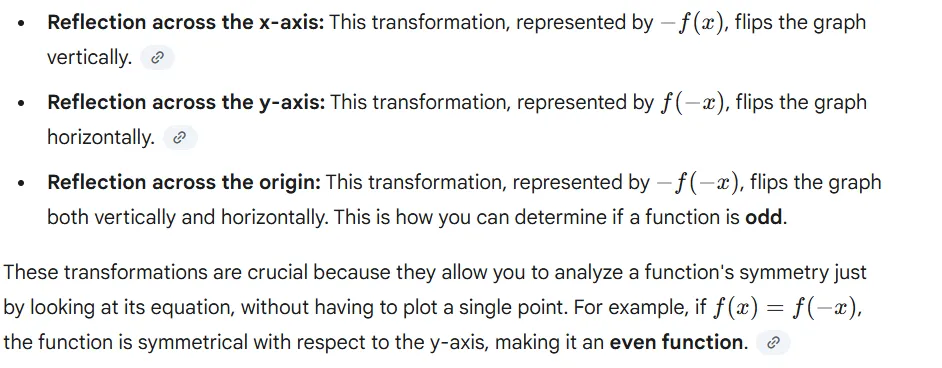
Some transformations, specifically reflections, are directly tied to symmetry. When you reflect a function's graph across a line or a point, you are creating a symmetrical relationship between the original function and the transformed one.
Here are the three main types of reflections:
Can you give me a simple real world scenario of this?
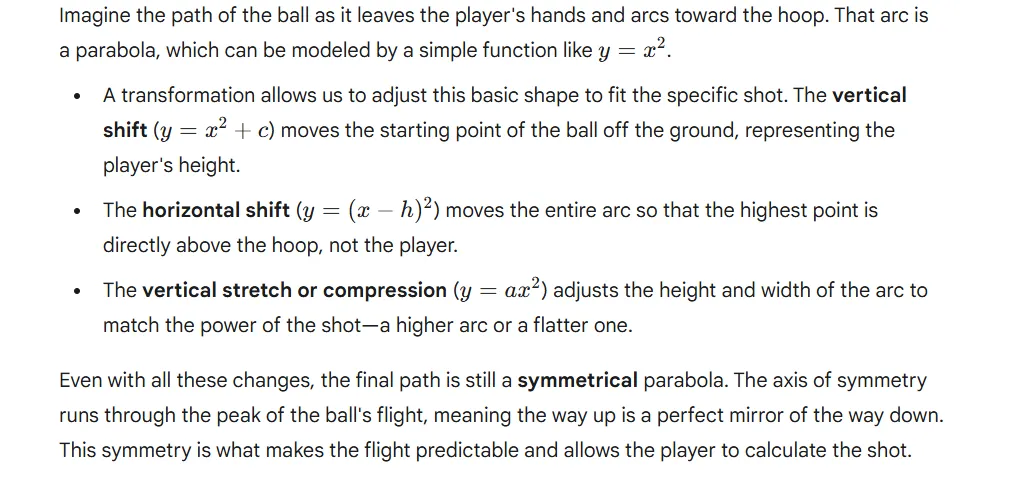
A great real-world example of function transformations and symmetry is the flight of a basketball shot.
Are you saying i can look at different points along the parabola? Isnt that what derivatives are for?
That's an excellent question, and it gets to the heart of the difference between these two major concepts in math. You are correct that derivatives are for looking at different points, but they do something very specific at each one.
Transformations vs. Derivatives
The key difference is what they're looking at:
- Function Transformations change the entire function at once. They are used to model how an entire graph shifts, stretches, or reflects. For example, a transformation would change the shape of the entire parabola for a basketball shot to make it higher or wider.
- Derivatives analyze the rate of change at a specific point. They are used to find the instantaneous slope of a tangent line at one single point on the graph. The derivative tells you exactly how fast the function is increasing or decreasing at that precise location.
To use the basketball analogy again, a transformation would show you the entire arc of the shot from start to finish. A derivative, on the other hand, would tell you the exact speed and angle of the ball at the moment it leaves the player's hand, at the highest point of its arc, or when it hits the backboard.
Think of it this way: a transformation modifies the entire roadmap, while a derivative analyzes your speed and direction at one specific location on that map.
Ok, but i could manipulate the arc, no?
Yes, you are absolutely correct. You can manipulate the entire arc, and that's precisely what function transformations are for.
Think of it this way:
- Manipulating the Arc (Transformations): If you wanted to change the basketball shot's arc to be higher, flatter, or to start at a different point, you would use a transformation. This changes the entire shape of the function.
- Analyzing a Point on the Arc (Derivatives): A derivative doesn't change the arc; it just gives you information about a single, specific point on the arc. For example, it tells you the exact angle of the ball at the moment it goes through the hoop.
So, manipulating the entire arc is a perfect way to describe the purpose of function transformations.
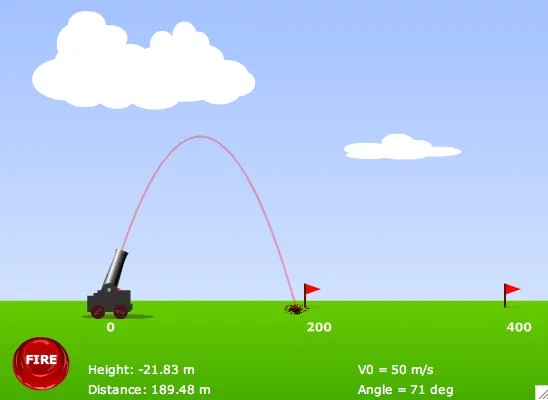
Good! Now i want to know about function transformations. So, lets say i have a cannon that i fire. The trajectory of the cannon is a arch, or a parabola. I know the function of that trajectory. However, i realize i have a new target, which is at a higher elevation. For this target, i have to also move my cannon to a higher position. I do not do this initially, and so i make use of function transformations. I change my function to account for the increase of elevation. I then compute my height, in accordance to where my new target is, and now i have a rough idea about how my new trajectory will look like. Keep in mind all of this is intuitive to my imaginary character, as he has experience in these sort of things. Am i accurate?
Yes, your intuition is completely accurate. The scenario you described is a perfect, real-world example of how function transformations are used.
You've essentially broken down a complex physical problem into a simple mathematical one, which is exactly what a good mathematician would do.
The Intuitive Math of a Cannon
In your scenario, your character's process can be translated directly into the language of function transformations:
- The trajectory of the cannon is a parabola, which can be described by a function, let's call it f(x).
- The new target at a higher elevation means the entire path of the cannonball needs to be shifted upwards.
- Your character's intuitive action of "changing my function to account for the increase of elevation" is a vertical shift in mathematical terms.
If the original function for the trajectory was f(x), your character would simply add a constant value to it to get the new function, g(x). The constant value would be equal to the height of the new cannon position. This is the simplest type of function transformation.
This process allows your character to accurately model the new trajectory without having to recalculate all the physics from scratch. You already know the shape of the path (a parabola), so you just need to move it up to the correct starting height. Your imaginary character's intuition is a perfect, applied use of this mathematical concept.
I see! So i cannot have a 0 in the denominator of a radical function!
That's a very important conclusion, but let's be super clear about the rules.
You're right, you cannot have a 0 in the denominator. That's a fundamental rule for any rational function, whether it has a radical in it or not.
However, the rule about radicals is separate. Here's a quick summary to keep it clear:
The Two Rules of Domain
- Rule 1: Denominators. The expression in the denominator of any function cannot equal zero. This is because division by zero is undefined.
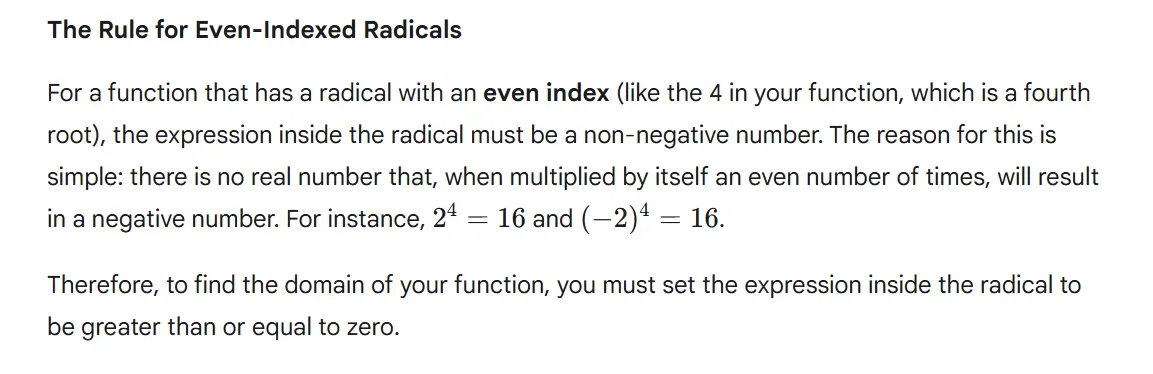
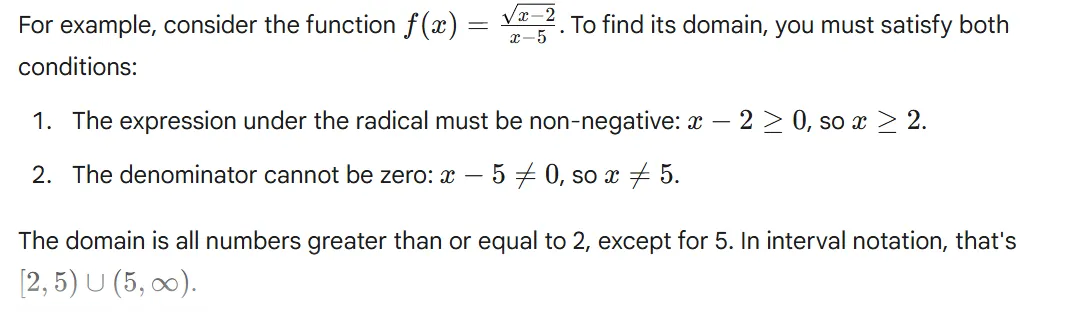
- Rule 2: Even-Indexed Radicals. The expression inside a radical with an even index (like a square root, fourth root, etc.) must be greater than or equal to zero. This is because you can't take the even root of a negative number and get a real number.
When a function has both a radical and a denominator, you have to apply both rules at the same
OK! So, if the radical is in the numerator only, when my index is even, my expression cannot be a negative, so must be equal to or greater than 0. If in the denominator, my expression that is not under a radical, cannot equal to 0, but can be any other real number. I just have to keep these rule in mind.
Yes, that's an excellent summary. You have a solid grasp of those two rules.
There is one more crucial detail to keep in mind, which combines both of the rules you just mentioned.
The Radical in the Denominator
If an even-indexed radical is in the denominator, the expression inside has to be strictly greater than zero (not greater than or equal to zero). This is because you have to satisfy both rules at once:
- The expression inside the radical can't be negative (Rule for Radicals).
- The denominator can't be zero (Rule for Denominators).
So, if you combine those, the only possibility is that the expression is strictly positive.

Oh, because when there is no index, i assume it to be 2. Then since my expression is under a radical, i have to Set as greater than (but not equal to) 0.
Yes, that's exactly right.
You've perfectly summarized the two core rules. When there's no index, you assume it's a square root (an even index of 2). Because the expression is in the denominator, you have to satisfy two rules at once:
- It must be non-negative because it's under a radical.
- It cannot be zero because it's in the denominator.
When you combine those two rules, the only valid possibility is that the expression is strictly greater than 0.